
France: Last execution by guillotine – Young Arab’s head fell into the basket
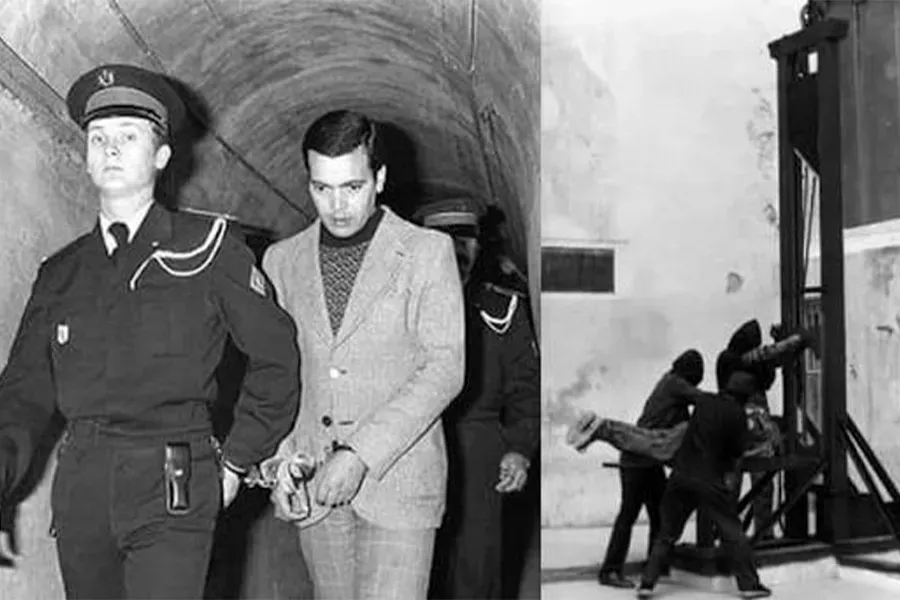
“It is at that very moment that he begins to understand that everything is over”
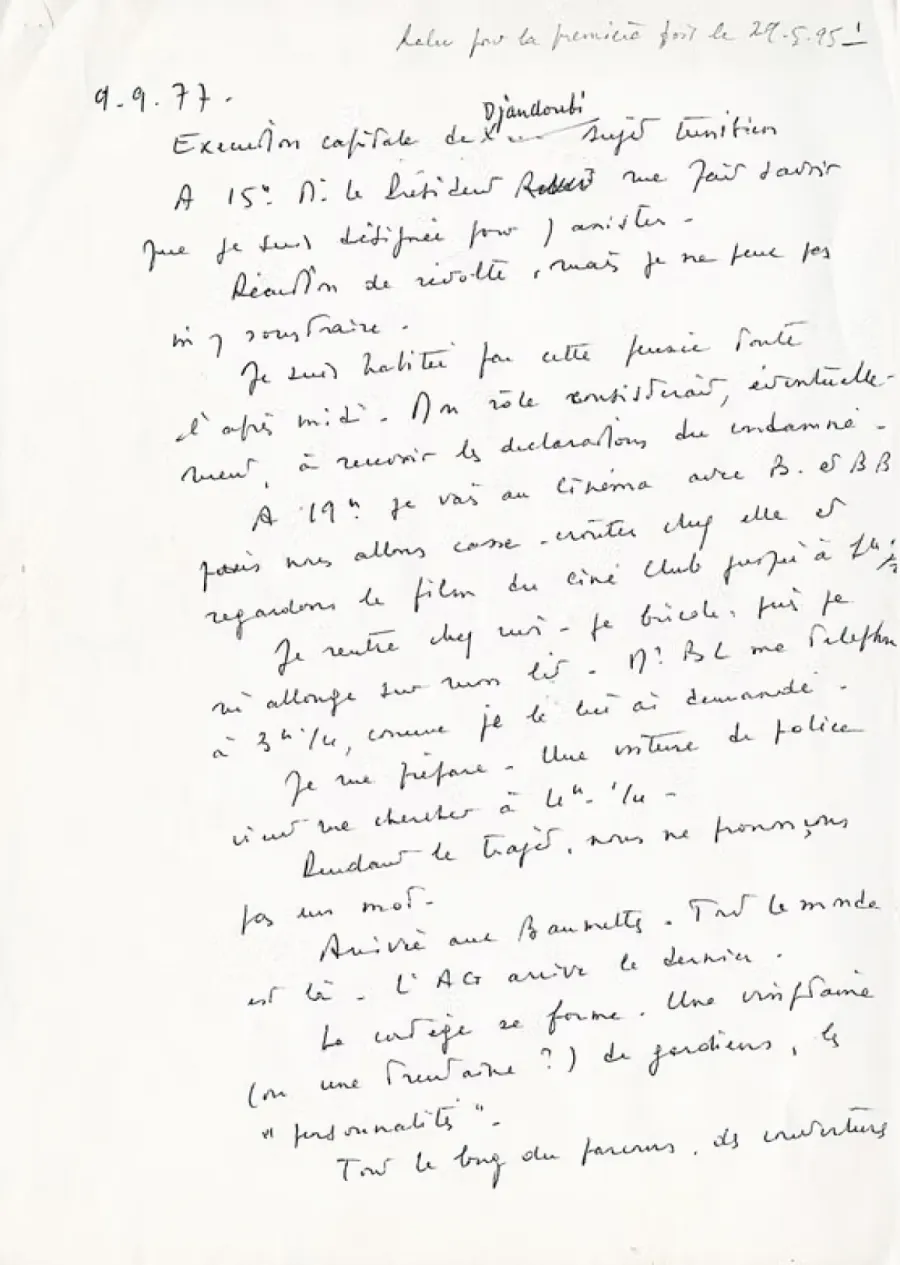
A historical document describing the final moments of Hamida Djandoubi, the last person to be executed by guillotine in France, in September 1977. The document was presented to Le Monde by former Justice Minister Robert Badinter.
Monique Mabelly — Investigating Judge
This is a historical document presented to Le Monde by former Justice Minister Robert Badinter, one of the forgotten fragments of our collective memory — a restrained yet devastating testimony. It is an unofficial, personal “record” of the last death sentence carried out in France. On September 9, 1977, Tunisian worker Hamida Djandoubi, convicted of murdering his girlfriend Élisabeth Bousquet, was executed by guillotine at Baumettes Prison in Marseille. Monique Mabelly (1924–2012), the city’s most experienced investigating judge, who had been assigned to attend the execution, put on paper what she saw and felt immediately afterwards.
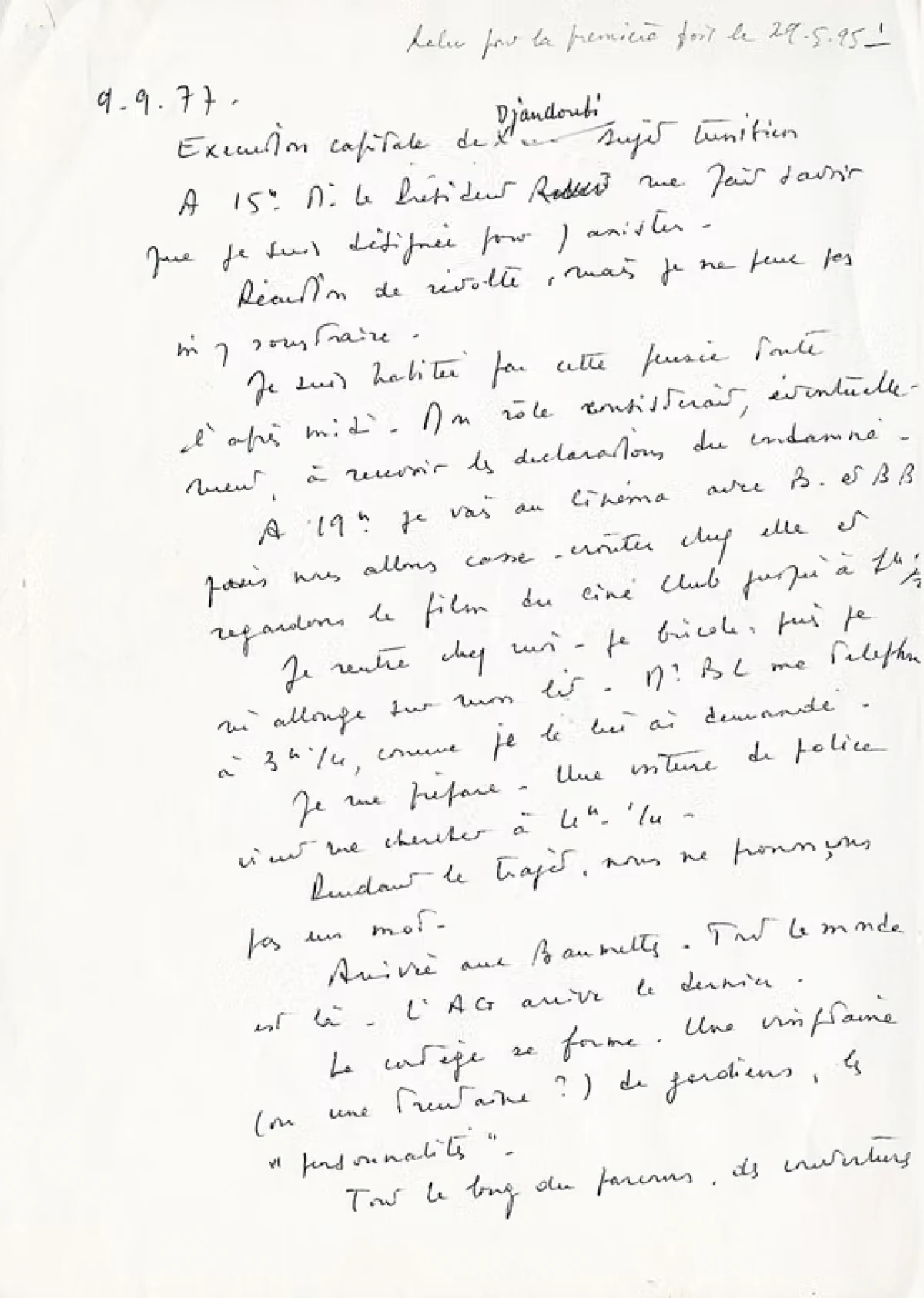
The three-page text describing Hamida Djandoubi’s final minutes is restrained, yet at the same time filled with horror and suppressed anger. The author meticulously records the minutes from the moment they enter the prisoner’s cell until he is taken to the guillotine, his hesitation over his final cigarette, his futile attempts to delay the inevitable moment, and the blade that cuts his body in two. These are lines written immediately after returning from an execution that left her with a feeling of “cold revolt”. Ten years later, Monique Mabelly would bequeath the manuscript to her son, Rémi Ottaviano, who would hand it over to Robert Badinter several weeks ago.
September 9, 1977
Execution of Tunisian national Djandoubi.
At 3:00 p.m., Mr S. R… informed me that I had been assigned to attend the execution.
A feeling of revolt rose within me, but I could not refuse. I spent the entire afternoon with this thought. My duty was to receive the prisoner’s final words, should the need arise.
At 7:00 p.m., I went to the cinema with B. and B. B., then we had a light dinner at his home and watched a film at the Ciné-Club until 1:00 a.m. I returned home, took care of a few minor things and then went to bed. Mr B. L. called me at 3:15 a.m., as I had asked him to. I got ready. A police car came to pick me up at 4:15 a.m. We did not say a word during the journey.
We arrived at Baumettes Prison. Everyone was there. The prosecutor general arrived last. The group was assembled: around twenty or thirty guards and officials. Brown coverings had been laid on the floor along the entire route to muffle the sound of footsteps. At three points along the route, tables had been placed with basins filled with water and terry towels.
The cell door was opened. I heard that the prisoner had been dozing but was not asleep. They were “preparing” him. This took some time because he had a prosthetic leg that had to be fitted. We waited. No one spoke. I think this silence and the prisoner’s outward compliance reassured those present. No one would have wanted to hear screams or protests. The group formed again and we returned along the same route. The coverings on the floor had already shifted somewhat, and less attention was being paid to muffling the sound of footsteps.
The group stopped beside one of the tables. The prisoner was seated on a chair. His hands were cuffed behind his back. A guard gave him a filtered cigarette. Without saying a word, he began smoking. He was young. His hair was jet black and neatly combed. His face was quite handsome, with regular features, but he was pale and had dark circles under his eyes. There was no trace of stupidity or brutality in him. On the contrary, he was a handsome young man. He smoked and immediately complained that the handcuffs were too tight. A guard approached and tried to loosen them. He complained again. At that moment, I saw a thin rope in the hands of the executioner, who was standing behind him with his two assistants.
For a moment, I thought they might replace the handcuffs with the rope, but they simply removed the handcuffs, and the executioner uttered those dreadful, tragic words: “You see, you are free!…” Those words make one shudder… He smoked the cigarette, which he had almost finished, and was given another. His hands were now free, and he smoked slowly. It was at that very moment that I saw that he was beginning to truly understand that everything was over — that escape was impossible — and that his life and the final moments remaining to him would last only until this cigarette was finished.
THIS MAN WILL DIE, AND HE KNOWS IT
He called for his lawyers. Mr P. and Mr Q. approached. He spoke to the lawyers as quietly as possible, because the executioner’s two assistants were standing right beside him, as though they wanted to take away even these final moments in which a human being was still alive. He gave Mr P. a piece of paper, and the lawyer tore it up at his request; he handed Mr Q. an envelope. He spoke very little with them. The lawyers stood on either side of him and did not speak to each other either. The waiting dragged on. He called the prison governor and asked about what would happen to his personal belongings.
The second cigarette was also finished. About fifteen minutes had now passed. A young and friendly guard approached with a bottle of rum and a glass. He asked the prisoner if he wanted a drink and poured half a glass. The prisoner began drinking slowly. He now understood that when he finished the drink, his life would end as well. He spoke with his lawyers for a little while longer. He called the guard who had given him the rum and asked him to collect the pieces of paper that Mr P. had torn up and thrown on the floor. The guard bent down, gathered the pieces and handed them to Mr P., who put them in his pocket.
It was at this moment that emotions began to intermingle. This man will die, and he knows it; he knows there is nothing he can do except delay the end by a few minutes. And it begins to resemble a child’s caprice, using every excuse to postpone bedtime! Like a child who knows he will be indulged and takes advantage of it. The prisoner continued drinking from his glass in small, slow sips. He called for the imam; the imam approached and spoke to him in Arabic. He replied with a few words in Arabic.
The glass was almost empty and, in one final attempt, he asked for another cigarette — a Gauloise or a Gitane, because he had not liked the cigarette he had been given. He made the request calmly, almost with dignity. But the executioner, who was already becoming impatient, intervened: “We have been understanding enough, compassionate enough toward him. It is time to finish.” The prosecutor general, for his part, also refused to give him the cigarette, despite the prisoner insisting that “This will be the last one.” An uneasy atmosphere began to take hold. About twenty minutes had passed since the prisoner sat down on the chair. Twenty minutes that seemed both very long and very short! Everything became confused.
THE TRACES OF THE CRIME MUST BE REMOVED IMMEDIATELY…
This final request for a cigarette restores its own reality, its own “identity”, to the time that has passed. For twenty minutes, everyone had patiently waited while standing, and the seated prisoner’s requests had been immediately fulfilled. Control over this period had been left to him; these were his personal moments. Now another reality takes the place of the time granted to him. Time is taken back from him. The final cigarette is refused, and he is told to quickly finish his glass so that the proceedings can be completed. He takes the last sip and hands the glass to the guard. Immediately, one of the executioner’s assistants swiftly pulls a pair of scissors from his jacket pocket and begins cutting the collar of the prisoner’s blue shirt. The executioner signals that the opening is not wide enough. To make the task easier, the assistant makes two large cuts into the back of the shirt with the scissors, exposing the entire upper part of his back.
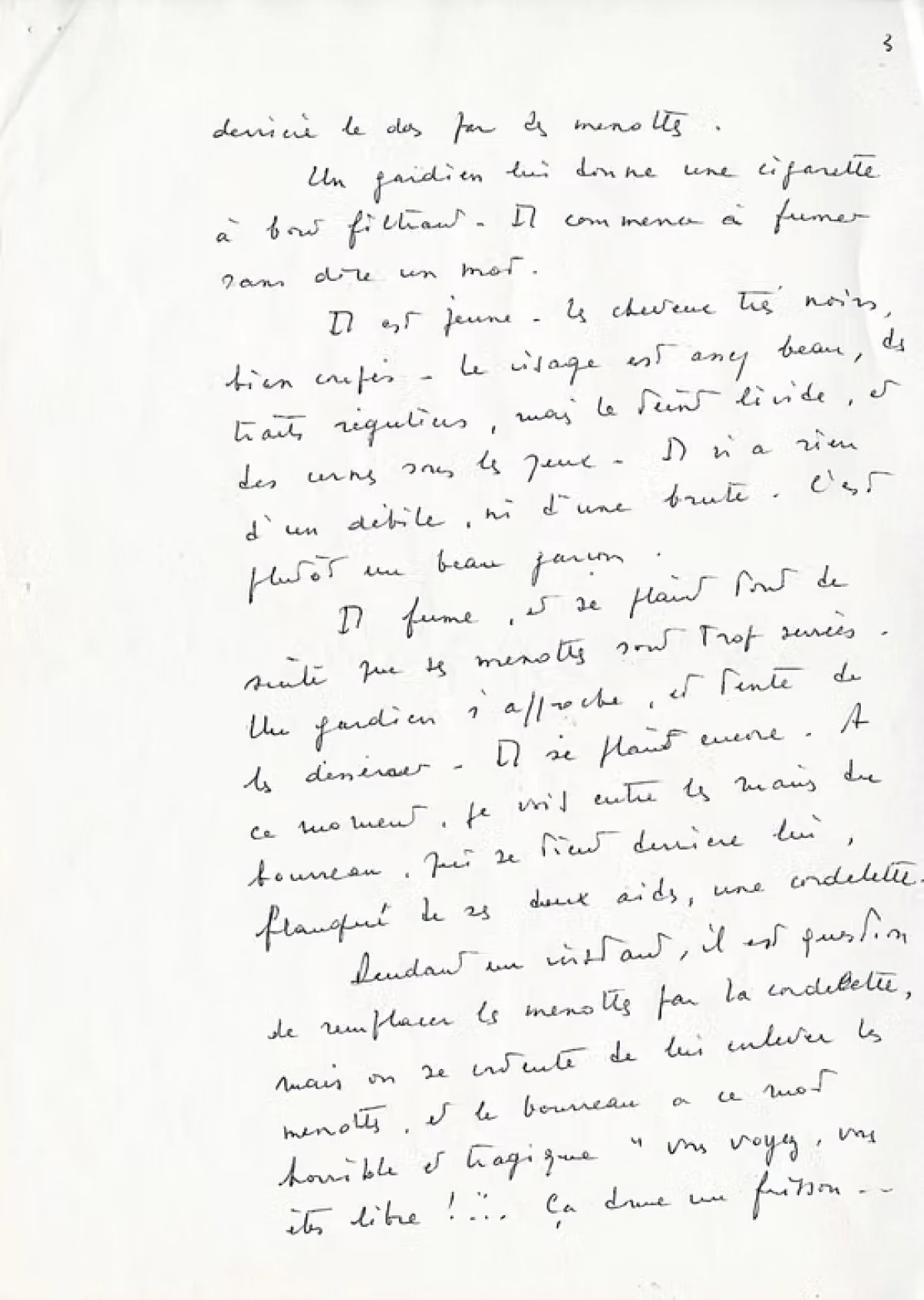
In a swift movement, before cutting the collar, they tie his hands behind his back with the thin rope. The prisoner is made to stand. The guards open one of the doors in the corridor. The guillotine is visible in front of the door. After the guards push the prisoner forward, I follow them almost without hesitation and enter the room where the “machine” is located, perhaps the inner courtyard. To the side, there is an open wicker basket, brown in colour. Everything happens with lightning speed. They throw the body down almost face-first, but at that moment I turn my face away — not because I am about to “break down” from fear, but simply out of instinctive, inner modesty; I cannot find another word for it.
I hear a muffled sound. I turn back. Blood, far too much blood, bright red blood; the body has spilled into the basket. In a single second, a human life has been cut short and discarded. The man who was speaking a minute earlier is now nothing more than the blue pyjamas inside the basket. One of the guards takes a water hose. The traces of the crime must be cleaned up immediately… I feel nauseous, but I restrain my emotions. A wave of cold revolt runs through me.
We move into the room. There, the prosecutor general busies himself with childish haste, preparing the official record. D. carefully checks every word. After all, the official record of the execution of a death sentence is an important matter! At 5:10 a.m., I am already home.
I am writing these lines. It is 6:10 a.m.
Translated from French by: Aziz Alibeyli
PHOTOS