Iran is heading towards collapse – A 40-million-strong Azerbaijani state could emerge in the region
The long-running Cold War in the Middle East is moving into a phase of open military confrontation. In particular, the prospect of large-scale strikes against Iran by a US-Israeli coalition has brought the region’s borders, which have remained largely untouched for a century, back into the spotlight. At the centre of these discussions is arguably the most explosive and decisive factor: Iran’s ethnic Azerbaijanis, or the South Azerbaijan issue. If the Tehran regime were to lose control of the country during a potential military escalation, the idea of a “United Azerbaijan”, long regarded as a romantic aspiration, could suddenly become a hard and seemingly inevitable geopolitical reality.
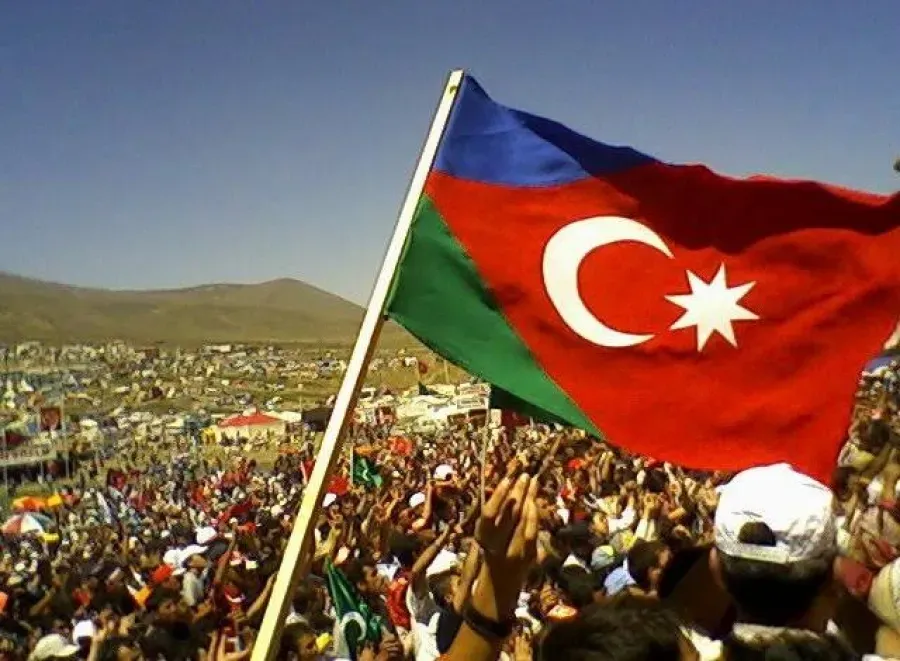
A closer look reveals that Iran is not a monolithic Persian state, as some might assume. Of its estimated 85–90 million people, at least 40–45 million are Azerbaijani Turks. They live in concentrated communities in the country’s north-western provinces, including Tabriz, Urmia, Ardabil and Zanjan, while also playing a major role in the industrial and commercial life of the capital, Tehran. This demographic weight accounts for approximately 40% of Iran’s total population. Despite decades of assimilation policies pursued by the regime, the suppression of national identity and environmental and social pressures, including the drying up of Lake Urmia, calls for national awakening and self-determination in the region have arguably never been as widespread as they are today.
If devastating foreign military strikes against Iran were to begin and Tehran’s central security apparatus, particularly the Islamic Revolutionary Guard Corps (IRGC) command structure, were paralysed, the resulting power vacuum could quickly spread to the country’s ethnic peripheries. Just as separatist tendencies could emerge in Arab-populated Ahvaz, Kurdish-majority areas and Balochistan in the first days of weakened central authority, one possible scenario in South Azerbaijan would be for the national movement to assume de facto control and establish self-governing institutions. At such a historic moment, the prospect of more than 40 million people determining their own future, and of the two sides of the Araz River uniting politically, economically or in a confederation, could emerge not merely as an expression of popular will but also as a new regional security imperative.
Such territorial and demographic changes could fundamentally reshape the geostrategic map of Eurasia. Any form of integration between North and South Azerbaijan, or the emergence of an independent Turkic state in the south, would transform logistics routes stretching from the Caspian Sea to the Persian Gulf and create a powerful Turkic belt of 40–50 million people. This would also mean establishing a direct and uninterrupted land connection with Türkiye, while projects such as the Zangezur Corridor could become an indispensable global artery. Such a configuration would significantly restrict Russia’s influence in the south and dismantle the “Iranian shield” on which Armenia has relied for years, leaving Yerevan surrounded by the Turkic world.
Of course, these developments would not unfold smoothly or without losses. The movement of millions of people across borders, a possible refugee wave and provocations that Persian nationalism could trigger at the last moment would place extraordinary military, economic and humanitarian responsibilities on both Baku and Ankara. Yet one fact remains: artificial systems established in the Middle East as empires are heading towards collapse. If strikes by a Western coalition push Tehran’s current regime into a process of internal fragmentation, every new border drawn in the region will be shaped by the South Azerbaijan factor, and the Azerbaijani people will face one of the greatest geopolitical tests in their history: bringing a century of separation to an end.
Ismayil Shahli