Armenians’ favourite Arab wins election in US – Takes aim at Azerbaijan
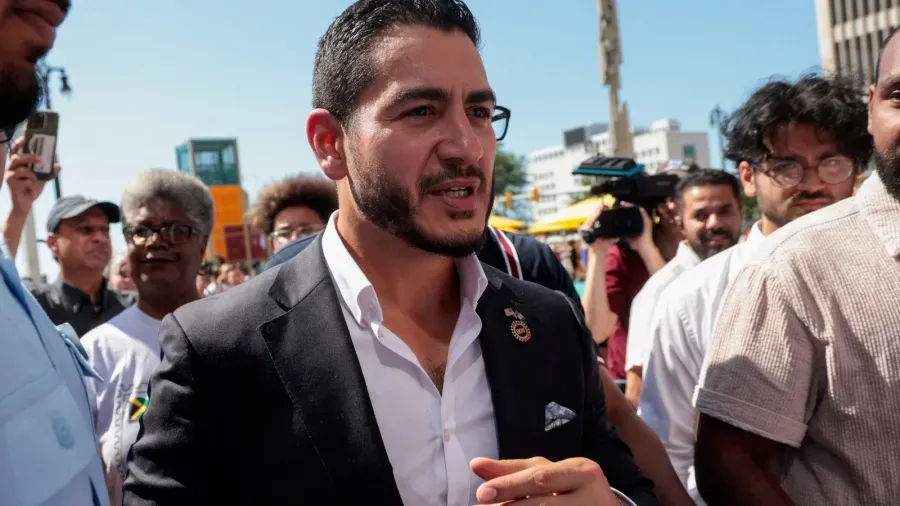
The fact that approximately 60% of Jewish voters in Michigan supported progressive Muslim candidate Abdul El-Sayed, a staunch anti-war figure who has accused Netanyahu of war crimes, came as a major surprise.
It appears that a fundamental turning point is taking place in US domestic politics, particularly in the Democratic Party’s internal evolution.
For young and left-leaning liberals in the United States in particular, ethnic or religious affiliation has taken a back seat, while human rights, international humanitarian law and progressive values have become the main political criteria.
However, from Baku’s perspective, this ideological shift has an entirely different dimension. The reason is that the “new wave” represented by left-progressive figures such as Abdul El-Sayed, Ilhan Omar, Rashida Tlaib and Bernie Sanders, while championing human rights on the issue of Palestine, has also become among the most radical defenders of the Armenian lobby’s claims of alleged “human rights violations and ethnic cleansing” in the South Caucasus.
The following are the main arguments and factors shaping the progressive and liberal wing of the US Democratic Party’s attitude towards Baku:
The Israel-Azerbaijan strategic partnership is directly targeted by this group. The Democrats’ left wing strongly criticises Netanyahu’s far-right cabinet and Israel’s military apparatus. Azerbaijan’s extensive military-technical, intelligence and energy cooperation with Israel – particularly the fact that more than 40% of Israel’s crude oil imports are supplied through the Baku-Tbilisi-Ceyhan pipeline, and that the Azerbaijani army is equipped with modern Israeli drones and missile systems such as Harop, Barak-8 and LORA – leads these circles to label Baku a “partner of the Netanyahu regime”.
An ideological alliance with the Armenian lobby is taking shape. The Armenian National Committee of America (ANCA) and the Armenian Assembly have for years built their campaigns in influential states with strong left-wing and liberal constituencies, such as Michigan, California and New York, by working through progressive politicians of this kind. They seek to present the Karabakh issue to Western public opinion not as a geopolitical conflict, but as a violation of the rights of an “oppressed people”, drawing parallels with events in Gaza. It is precisely as a result of this ideological manipulation, the article argues, that these progressive Democrats are among those at the forefront of calls in Congress to tighten Section 907 restrictions against Azerbaijan, completely halt military aid and impose sanctions on Azerbaijani officials.
“Values-based diplomacy” is taking precedence over realpolitik. While Republican administrations tend to view issues through the lens of pragmatic interests, raw materials and energy security, and efforts to put pressure on Iran from the south and north, this Democratic faction reduces international relations to a framework of “the struggle between authoritarianism and democracy”. It ignores the new realities Azerbaijan has established in the region, Armenia’s 30-year occupation and the violated rights of one million Azerbaijanis, while persistently accusing Baku over various issues.
This dynamic suggests that as long as the Democratic Party remains in power in Washington, and particularly while its left-liberal wing dictates the party’s foreign policy agenda, relations with official Baku will continue to face headwinds. Pressure on Azerbaijan from the White House and Congress – including sanctions initiatives, restrictions on military cooperation and overt political support for Armenia – is unlikely to ease.
However, this does not mean that Azerbaijan should take a step back. On the contrary, amid this environment of double standards, Baku should strengthen its engagement with other centres of influence in the United States, pragmatic Republicans and oil and energy lobbies. It should also demonstrate, with strategic composure, that the regional alliance it has built with Israel and Türkiye is indispensable to Washington.
Ismayil Shahli