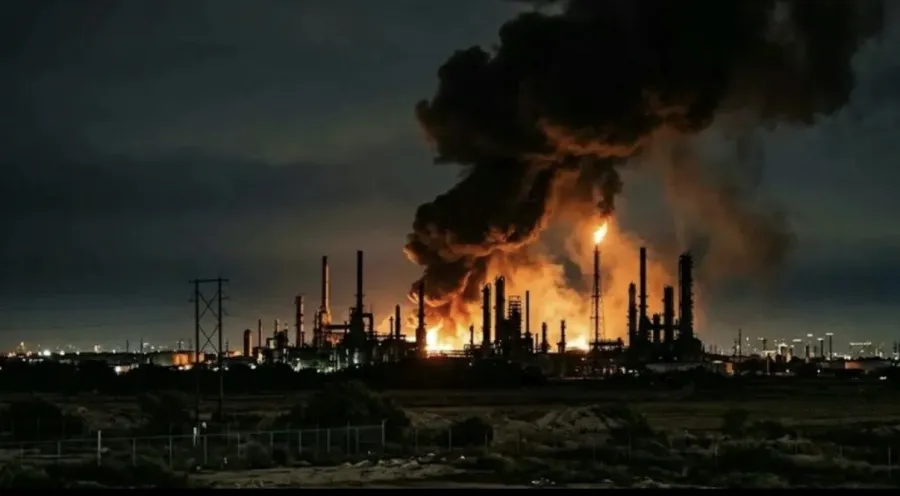
Food supplies being stockpiled, power and internet to be cut – Date set for the end of the world
Doomsday scenarios, claims of a global internet blackout and food shortages circulating in recent days around November 13 and 17 have sparked panic on social media.
TodayPress TV reports, citing Lent.az, that the outlet has examined warnings and doomsday predictions spreading across various countries.
One of the dates most widely discussed on social media in recent days is November 13, 2026. According to the claims, humanity could face a major catastrophe on that day.
Interestingly, the date is not entirely fabricated. It is based on a scientific paper published in the prestigious journal Science in 1960. Physicist Heinz von Foerster and his colleagues Patricia Mora and Lawrence Amiot calculated the rate of global population growth and suggested that a mathematical model would reach an impossible outcome on November 13, 2026.
However, the study did not predict that the world would physically come to an end. The model was based on the assumption that population growth would continue indefinitely at its previous rate. The subsequent decline in birth rates has rendered that prediction invalid.
Nevertheless, a mathematical model developed 66 years ago is now being presented on social media as a warning about the end of the world.
Will the internet and banks shut down on November 17?
A second major wave of panic concerns November 17. According to an investigation published on November 3 by Kazakhstan’s Tengrinews, a social media user identifying himself as Wesley claimed, citing unidentified sources, that a global cyberattack would take place on that date.
The claims suggest that banking systems, the internet and other essential services will stop functioning. People are being advised to stock up on food, water, cash and even gold in advance.
However, no reliable evidence has been found to support these claims. A scheduled test of the emergency alert system in the United States on November 17 has also been misrepresented in some posts as a sign of a major power outage.
Have “The Simpsons” joined the panic?
Social media users are also claiming that the popular animated series The Simpsons supposedly predicted a global energy crisis.
They are linking an episode broadcast in 2023, which features a power outage, to November 2026.
In reality, the episode does not predict a worldwide blackout on a specific date. The spread of a fictional event from the series as a warning of a real catastrophe illustrates how misinformation takes shape.
Why are people being advised to stock up on food?
Some of the information causing panic is actually based on recommendations issued by government institutions. In March 2025, the European Commission presented an emergency preparedness strategy. The document emphasises the importance of citizens being able to meet their basic needs independently for at least 72 hours during a potential crisis.
On November 3, 2026, the European Commission also issued new recommendations in this area. In Sweden, citizens are advised to prepare supplies for one week in case of war, natural disasters or infrastructure disruptions. Similar recommendations exist in Japan and the United Kingdom.
There is, however, an important distinction: governments are advising people to prepare for emergencies, not announcing that the end of the world is approaching.
Will Azerbaijan also face food shortages?
In recent days, alarming claims concerning Azerbaijan have also been circulating on social media.
According to these claims, supermarkets in the country could be targeted by cyberattacks, stores could be forced to suspend operations, and the population might have to stock up on three days’ worth of food.
An investigation published on November 4 by the Factcheck platform Faktyoxla states that no official warning of such a threat has been issued.
Azerbaijan’s Ministry of Emergency Situations does indeed advise citizens to prepare emergency kits. Its official website recommends keeping at least three days’ worth of non-perishable food, water, medication, documents and a flashlight in such a kit.
However, this recommendation is not new and does not mean that Azerbaijan is about to face a food, electricity or internet crisis.
Are astrologers spreading these claims, or are other forces behind them?
Various sources are involved in spreading doomsday claims. These include social media accounts sharing mystical predictions, individuals offering their own interpretations of religious texts, conspiracy theory proponents and content creators seeking sensational stories.
Although some posts refer to astrological and religious predictions, there is currently no reliable evidence identifying a particular astrologer as the source of the latest wave of panic.
The main problem is the combination of information taken from different sources. Earthquake preparedness measures in one country, cybersecurity concerns in another and preparations for a possible war in a third are being presented as signs of a single global catastrophe.
Is the world really in danger?
There are genuine risks that experts have drawn attention to. Cyberattacks, wars, extreme weather events and problems affecting energy infrastructure can disrupt services in individual countries.
However, these risks do not mean that electricity, internet access and food supplies will collapse simultaneously across the entire world.
At present, there is no reliable scientific evidence confirming that the world will end on November 13 or 17, or that global systems will collapse completely.
According to experts, being prepared for emergencies is a sensible measure. However, believing unverified warnings, engaging in panic buying, excessively stockpiling food and spreading alarming claims can create unnecessary fear.
Thus, claims circulating around the world that “there will be no food, the lights will go out and the internet will stop working” have emerged from a mixture of various genuine safety recommendations, outdated predictions and social media rumours. The key issue for people is not the dates being cited for the end of the world, but the ability to distinguish verified information from unfounded fear.
Zahra Mammadova