Names of stallions paired with Karabakh mares – LIST
2026 mating season and breeding programme at the Karabakh Horse Stud Farm
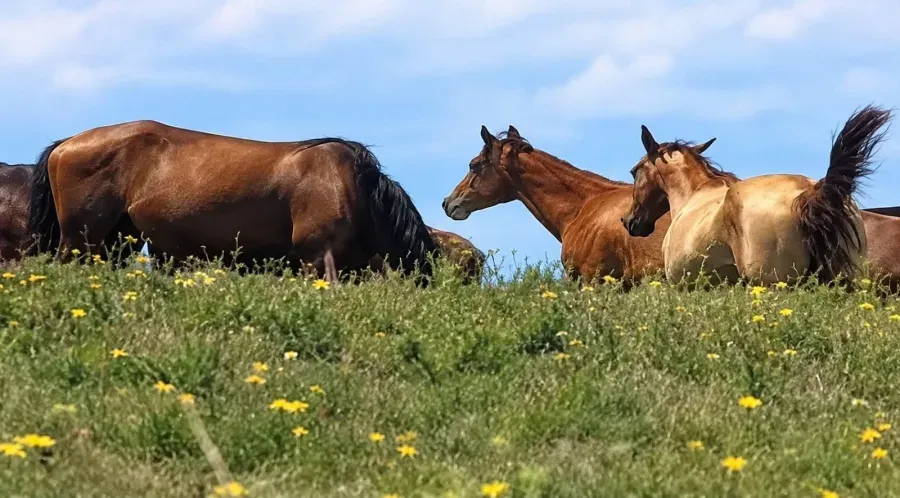
In 2026, more than 70 broodmares at the Karabakh Horse Stud Farm were paired with stallions using a selective matching method as part of the mating season.
The purebred breeding stallions used in the mating process and the farms or owners to which they belong are listed below:
1. Sovgat – A. Gadimov
2. Shafran – E. Karimov
3. Khan-Khan – Y. Guluzade
4. Sulfat – Karabakh Horse Stud Farm
5. Polad – Karabakh Horse Stud Farm
6. Ayaz – Karabakh Horse Stud Farm
7. Volga – Karabakh Horse Stud Farm
8. Armud – (Arabian/Karabakh) Qarb.AAZ
9. Usyan-Yashar – B. Nasibov
10. Sokrat – Gunay Equestrian Club
11. Tugyan – M. Abdullayev
12. Fagot – Karabakh Horse Stud Farm
13. Basarkechar – M. Abdullayev
14. Davud – Karabakh Horse Stud Farm
Organisation of selective pairing
The assignment of breeding stallions to broodmares was carried out in accordance with a breeding plan prepared in advance. The plan was developed with the participation of the stud farm’s animal breeding engineer, veterinarian and management, with the pairing of each stallion with suitable mares determined beforehand.
This year, the Karabakh Horse Stud Farm also engaged A. Orujov as a specialist. He previously worked as an animal breeding engineer at the Aghdam Horse Stud Farm and contributed to the preservation of the Karabakh horse breed.
Pairing is carried out taking into account each animal’s origin, breeding lineage, type, individual characteristics and working ability.
In the post-war years, the Karabakh Horse Stud Farm’s main breeding priorities have focused on restoring the core broodmare stock of the Karabakh horse breed, reviving its internal types and improving their breeding qualities.
The primary objective is to preserve and restore the Karabakh horse’s characteristic body structure, strong constitution, breed-specific traits and traditional breeding qualities.
One of the areas receiving particular attention in recent breeding work is the restoration of the herd’s traditional coat colours. Special emphasis is being placed on gradually restoring, through selective breeding, the distinctive glossy golden-yellow, brownish-yellow, deep yellow and yellow-chestnut shades characteristic of the Karabakh horse.
Thus, the work carried out during the 2026 mating season is intended to restore the breeding foundation of the breed’s maternal families, revive its internal types, improve the quality of the purebred population and preserve its traditional phenotypic characteristics.
Ismayil Shahli