
Iran criticizes the Zangezur corridor but reaches agreement with Armenia: What is Tehran’s goal?
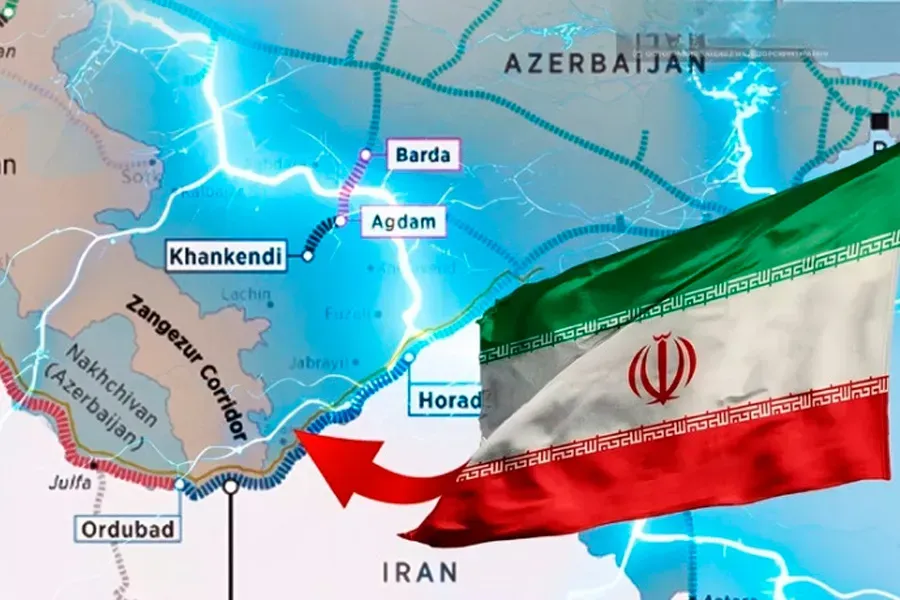
Iran and Armenia have agreed to establish a simplified (“green”) customs corridor along their shared border. According to reports, the agreement was reached during a meeting in Julfa between Iran’s Deputy Minister of Economic Affairs and Finance and head of the Customs Administration, Faroud Asgari, and Chairman of Armenia’s State Revenue Committee, Eduard Hakobyan.
At the end of the meeting, the sides signed a protocol on expanding customs cooperation between the Iranian Customs Administration and Armenia’s State Revenue Committee and simplifying customs procedures. They also agreed to introduce a simplified “green” customs corridor along the Iran-Armenia border. The establishment of a simplified customs corridor at the Norduz–Meghri border crossing is expected to speed up the completion of customs procedures and reduce cargo waiting times.
Iran criticizes US involvement in the Zangezur corridor while establishing a “green” corridor with Armenia. How should this be understood?

Speaking to TodayPress TV, political analyst Yusif Bagirzade said Iran’s agreement with Armenia to establish a simplified green customs corridor along the Norduz–Meghri route may initially appear contradictory to Tehran’s position on the Zangezur corridor, particularly regarding the growing role of the United States in the South Caucasus.
“However, in reality, Iran distinguishes between two different issues here. The first is facilitating trade across the existing Iran-Armenia state border, while the second concerns the legal and geopolitical model under which transport connectivity is organized through Armenian territory.
As a result of the recent meeting in Julfa, the sides signed a protocol on expanding customs cooperation, exchanging advance electronic information about cargo and accelerating customs procedures. According to the Armenian government, the ‘Simplified Customs Corridor’ primarily envisages easing control and clearance procedures for low-risk and compliant economic operators.”
According to the expert, this is essentially not the creation of a new geopolitical corridor:
“The issue is the faster and more efficient organization of cargo transportation using the existing Norduz–Meghri border crossing. This is also of major economic importance to Iran. Armenia is one of Iran’s routes to the Caucasus and, more broadly, to European markets. Tehran also does not want its border with Armenia to become weakened or its significance reduced as a result of regional connectivity projects.
This is precisely where the main difference with the Zangezur issue emerges. According to Iran’s official position, Tehran does not fundamentally object to the opening of communications in the South Caucasus. Its main condition is that the sovereignty and jurisdiction of the states through which the routes pass be preserved. Iran’s ambassador to Armenia, Mehdi Sobhani, also said in early September that all processes must be carried out within the framework of the sovereignty of the Armenian state.
Therefore, Iran’s concern currently relates less to the route itself than to its governance and security model. Naturally, there are other concerns as well, but since they cannot be put forward as the stated reasons, Tehran emphasizes issues of security, governance and sovereignty.
Tehran views new regional transport mechanisms being formed with US involvement as a potential instrument of the United States’ long-term strategic presence in the South Caucasus. Therefore, on the one hand, Tehran opposes such initiatives. At the same time, by expanding bilateral customs cooperation with Armenia, it is seeking to preserve its own economic and logistical presence in the region.”
According to Bagirzade’s assessment, two parallel lines can be seen in Iran’s policy in this area:
“To expand economic and transport ties with Armenia as much as possible, while preventing third countries, particularly the United States, from gaining a decisive role over transport and security infrastructure in the region.
From this perspective, the ‘green corridor’ can be viewed for Iran both as an economic project and as a means of preserving its regional transit role.
One of the important consequences of this agreement is that Tehran does not want to remain outside Armenia’s transport opportunities. On the contrary, by making its own routes and border crossings more efficient, Iran is seeking to remain an alternative and direct participant in the regional connectivity process.”
Giymat Mahir
PHOTOS