
Turkic countries that ban the hijab in schools – LIST
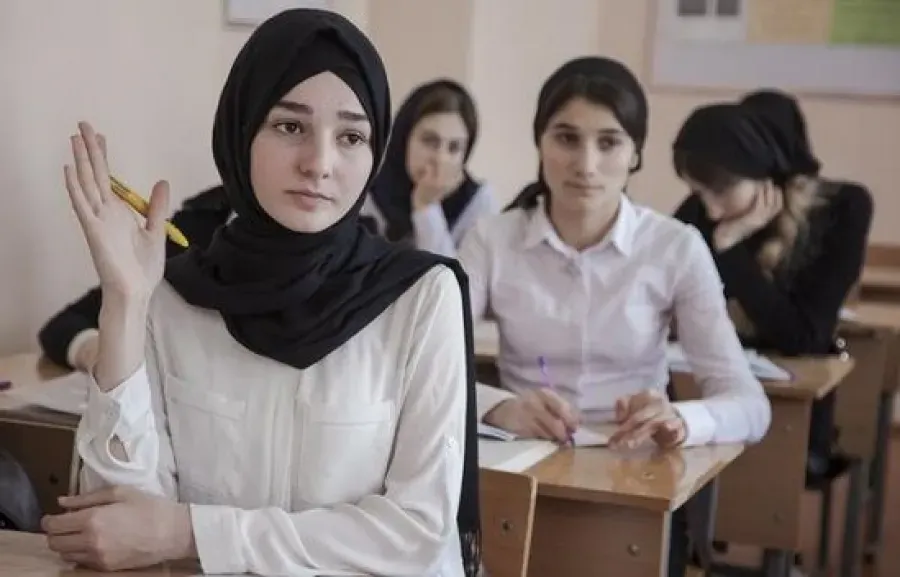
A decision signed several days ago in Azerbaijan prohibiting the use of clothing elements that violate the uniformity of the school uniform adopted in secondary schools, as well as other clothing elements that do not comply with the principle of secularism in general education, naturally raises the question: where does such a precedent exist among Turkic-Muslim countries?
TodayPress TV reports that in the Turkish Republic of Northern Cyprus, which Türkiye calls its “Yavru Vatan” (“Motherland’s little one”) and whose economic, social and international policies are closely linked to Türkiye, the issue of the hijab in secondary and higher education institutions became the subject of serious controversy in 2025.
Until March-April 2025, religious symbols, including head coverings (hijab/turban), were prohibited in secondary schools and high schools.
In March 2025, the Council of Ministers amended the disciplinary regulations, allowing high school students to wear head coverings in accordance with their beliefs, provided that the school uniform was not completely covered. In secondary schools, the decision was left to school administrations. Face-covering garments such as the niqab, burqa and face veil remained prohibited.
However, on September 25, 2025, the Supreme Court ruled that the amendment to the regulations was unconstitutional and annulled it. As a result, the situation returned to the status quo that existed before March 2025, and religious symbols and head coverings were prohibited in secondary schools.
In Kazakhstan, since 2016, elements of clothing indicating religious affiliation, including the hijab, have been prohibited under a decision by the Ministry of Education on school uniforms. The rule applies to both students and teachers.
The ban was tightened further in 2023, while in 2026 the Ministry of Education announced that the licenses of private schools failing to comply with the rule could be revoked.
Uzbekistan has prohibited the use of elements reflecting religious affiliation, including the hijab, in secondary schools since 2018 and does not allow head coverings inside schools. In 2021, however, an exception was introduced allowing the wearing of a national-style white or light-colored “romol” — a headscarf tied behind the neck — or a “doppi,” a traditional national cap.
Kyrgyzstan is the only country in the region without an official ban on the hijab. Hijabs are permitted in schools, although local disputes over uniform requirements have occurred in some areas. In recent years, the niqab has been banned, while simple hijabs have generally been tolerated.
In Turkmenistan, students’ clothing is strictly regulated by the government. State-prescribed national dress is imposed. The hijab is practically not accepted, with only traditional national head coverings permitted. Women, including teachers and students, are required to dress in accordance with the style prescribed by the state.
In Russia’s Republic of Tatarstan, there is no direct state-level ban on wearing head coverings, including the hijab or a simple headscarf, in schools. Since 2013, schools have required secular clothing.
Another Central Asian country, Tajikistan, has banned the hijab, as well as short skirts, in schools and universities since 2007. In 2024, the import, sale, promotion and use of clothing deemed “alien to national culture” was prohibited. Those violating the restrictions face heavy fines.
Girls and women wearing hijabs in Tajikistan face restrictions when entering state institutions, including schools.