
What would happen if we fell into a black hole?
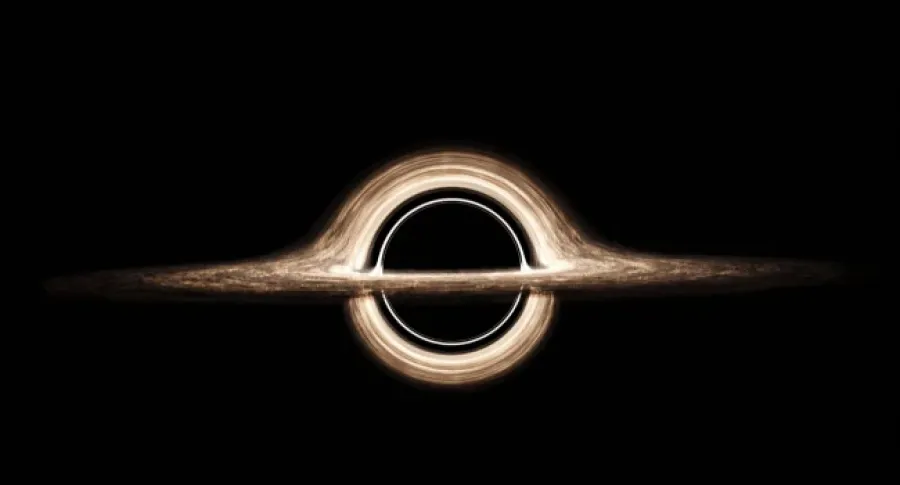
Falling into a black hole has long been one of the most popular plots in science fiction. But what would actually happen if a spacecraft came too close to such an object?
TodayPress TV reports that Sergey Pilipenko, chief researcher at the Astro Space Center of the P. N. Lebedev Physical Institute of the Russian Academy of Sciences, explained what effects the crew would experience and how supermassive black holes differ from “stellar-mass” black holes.
Time would accelerate significantly
Speaking to RIA Novosti, the scientist said that when falling into a supermassive black hole, time aboard the spacecraft would pass so differently compared with an outside observer that the crew could observe processes that would normally take millions of years. The movement of stars and even entire galaxies would appear to unfold before the crew’s eyes.
This is one of the relativistic effects described by the theory of general relativity. The closer an object gets to the event horizon, the slower time passes for an outside observer. For those falling inward, however, the picture is different: the outside Universe begins to appear to “spin” rapidly.
There is a major difference between supermassive and stellar-mass black holes
The size of a black hole plays an important role. In supermassive objects located at the centers of galaxies and with masses millions or even billions of times greater than that of the Sun, tidal forces near the event horizon are relatively weak. Therefore, in theory, a spacecraft could pass through the event horizon without being torn apart.
Even so, it would not be possible to see the center of the black hole — the singularity. According to Pilipenko, there would be another horizon between the spacecraft and the center of the black hole, and light from beyond it would not be able to reach the observers.
Those approaching a stellar-mass black hole would face a completely different situation. Here, tidal forces are enormous. The difference in gravitational force acting on different parts of an object becomes so strong that a spacecraft or any other object would most likely be torn apart before crossing the event horizon.
Research into black holes continues. Earlier, cosmologists suggested that primordial black holes formed before the Big Bang could have survived it and still exist today. Such ideas are associated with “cosmic bounce” models, in which the Universe first contracted and then began expanding.
For now, the main practical conclusion remains unchanged: supermassive black holes could theoretically allow observers to pass through the event horizon, but this would be accompanied by extremely unusual effects on the perception of time and space.
Astrophysicist Sergey Pilipenko said that the crew of a spacecraft falling into a supermassive black hole could, due to relativistic time effects, observe the movements of stars and galaxies that would take millions of years from an outside perspective. The spacecraft could cross the event horizon, but the center of the black hole would still remain invisible. In stellar-mass black holes, meanwhile, an object would most likely be torn apart by tidal forces before reaching the event horizon.
Giymat Mahir