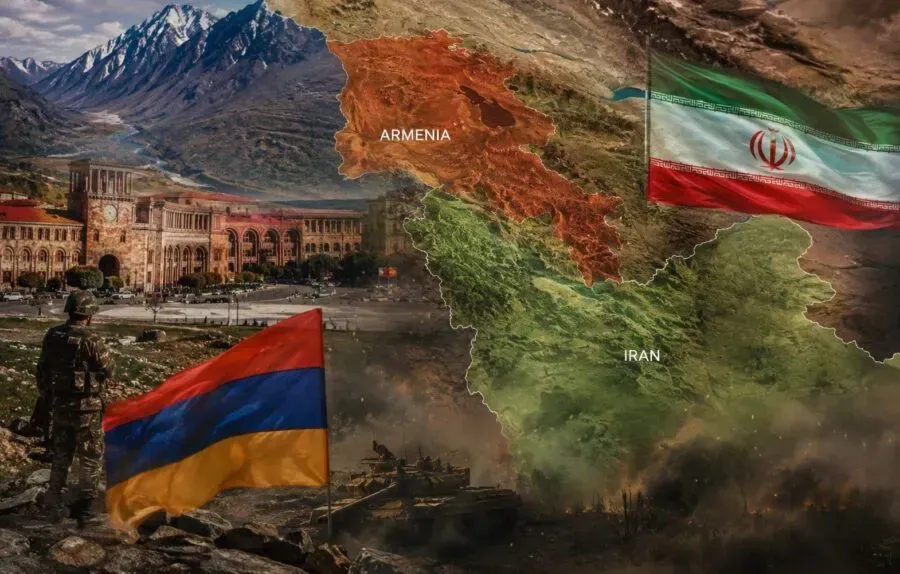
Tehran launches new attack on Azerbaijani identity: “Without Iran, Azerbaijan would not exist”
Tehran has once again resorted to an old narrative. This time, Iranian anti-Azerbaijani commentator Ehsan Movahedian has made a baseless claim against Azerbaijan, targeting the country’s cultural identity rather than geopolitics.
TodayPress TV reports that he made the remarks in a post on X.
He attempted to deny Azerbaijan’s national and cultural identity, claiming the tar as Iran’s heritage and effectively “gifting” the balaban to Armenians.
According to Movahedian, the tar, kamancha and nagara are supposedly of Iranian origin, while the balaban belongs to Armenians. He also claimed that mugham and meykhana derive from Iranian traditions. Going even further, he linked Azerbaijani folk tales to Talysh and Iranian folklore, ultimately revealing his political message: “Without Iran’s heritage, Azerbaijan would not exist.”
This is an apparent attempt at cultural appropriation and erasure of historical memory. However, Movahedian overlooks one important reality: cultural influences that have developed over centuries within a shared geographical region cannot be monopolised by a single state. Moreover, international records – particularly UNESCO’s official registers – contradict the Iranian commentator’s claims.
Movahedian’s portrayal of the tar as an exclusively Iranian instrument directly contradicts internationally recognised cultural records. In 2012, the art of crafting and performing the tar was inscribed on UNESCO’s Representative List of the Intangible Cultural Heritage of Humanity under Azerbaijan’s name. The document explicitly states that the instrument is traditionally crafted within Azerbaijani communities and is an integral part of the country’s national identity.
As for the kamancha, claiming that the instrument belongs exclusively to Iran is equally unfounded. In 2017, UNESCO inscribed the art of crafting and playing the kamancha on its list following a joint nomination by Azerbaijan and Iran. This means that its status as a shared cultural heritage of both countries has been internationally recognised – it is not the exclusive property of Tehran.
The Iranian commentator’s most absurd and biased claim concerns the balaban, which he attributes to Armenians. Movahedian appears either to be unaware of UNESCO’s 2023 decision or deliberately ignoring it. That year, the “Art of crafting and performing with Balaban/Mey” was recognised as intangible cultural heritage following a joint nomination by Azerbaijan and Türkiye. The inscription recognises the balaban tradition as Azerbaijani and the mey tradition as Turkish. Armenia has no historical or legal connection to this particular inscription.
Describing mugham as a derivative of Iranian music disregards the centuries-long development of Azerbaijan’s own performance tradition. In 2008, UNESCO recognised Azerbaijani mugham as an independent cultural heritage expression. Similarities with Iran’s radif, Iraq’s maqam and Türkiye’s makam are natural, but Azerbaijani mugham has its own distinctive improvisational approach and master-apprentice tradition.
Linking meykhana to Iran is, meanwhile, entirely devoid of academic basis. In Slavic Review, a journal published by Cambridge University Press, researcher Aneta Strzemżalska analyses meykhana as an improvised oral poetic declamation art that emerged within Azerbaijani society, describing it alongside mugham as one of Azerbaijan’s national symbols.
The claim that Azerbaijani folklore is supposedly of Talysh or Iranian origin is also contradicted by UNESCO records. In 2018, the heritage of Dede Qorqud – encompassing epic culture, folk tales and music – was recognised as a shared heritage of Azerbaijan, Kazakhstan and Türkiye. The Talysh people have their own rich folklore, but using it to deny Azerbaijan’s broader epic and folk-tale traditions is a form of manipulation. Also in 2018, UNESCO inscribed Yalli, a traditional Azerbaijani group dance, as another recognition of the country’s ancient dance culture.
Movahedian’s remarks are not a cultural discussion but part of a politically motivated narrative. The mutual influence of peoples who have lived in the same geographical region throughout history is inevitable. But using these shared influences to claim that “Without Iran, Azerbaijan would not exist” is a product of imperialist thinking. Azerbaijan’s statehood, language, mugham and traditional musical heritage are not so fragile that they can be erased by a couple of posts from Tehran’s social media trolls or political commentators.
Jala Rovshan