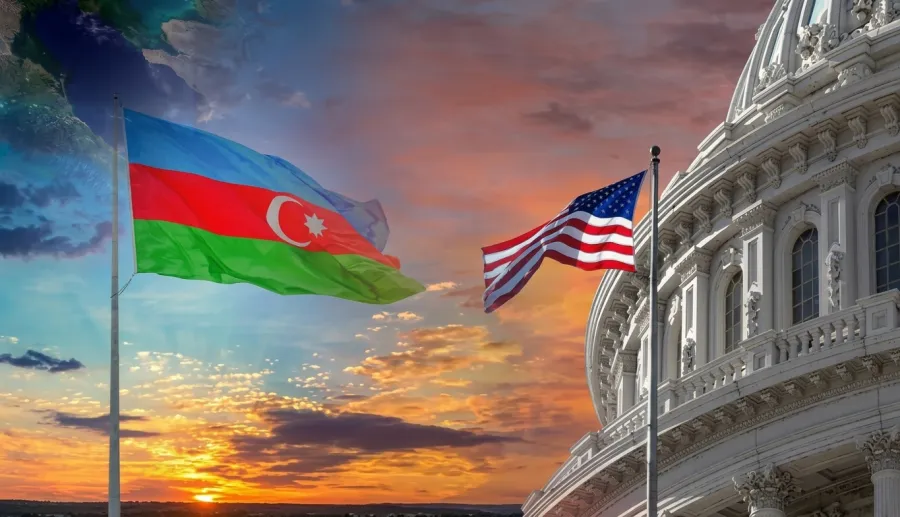

The victory flag – a benchmark of greatness and the Great Leader who never bowed
Thousands of states have emerged throughout world history, great empires have been established, and powerful armies have conquered entire continents. Many of them have survived only in history books; their borders have disappeared from maps, and their flags have become museum exhibits. The collapse of states was often declared through the occupation of their capitals, the defeat of their rulers, the surrender of their armies and the lowering of their flags from palaces and fortresses. Victors sought to raise their own flags first, because a flag is one of the most important symbols of statehood, demonstrating who holds power and whose political will prevails over a territory. Defeated armies have been rebuilt and destroyed cities reconstructed, but for peoples who lost their flags and statehood, the return to independence has sometimes taken centuries. The Azerbaijani people, too, regained their flag after enduring severe trials and passing through different political formations and systems.
There are various historical theories concerning the origins of flags. Even in the ancient states of the East, special insignia were used to distinguish rulers, tribes and military formations. The eagle emblem of the Roman legions, known as the aquila, was regarded as an inviolable symbol of military honour and unity. Its capture by the enemy was considered a grave disgrace for an entire legion. The Romans attached great political importance to recovering lost military standards. Following the collapse of the Western Roman Empire, the flags of the kingdoms, principalities and noble dynasties that emerged in Europe changed over the centuries. The military and dynastic banners of the Middle Ages gradually evolved into symbols of centralised states and, later, modern nations. Whereas in ancient times a flag represented a ruler's army, in subsequent centuries it came to embody the political unity of a people and state sovereignty. Thus, throughout the history of flags, colours and symbols also reflected changing foundations of statehood and evolving perceptions of the source of political authority.
The history of the British flag is an important example of how political unions are reflected in state symbols. The Cross of St George, representing England, and the Cross of St Andrew, representing Scotland, were combined into a single design in 1606. Following the political union of the two kingdoms in 1707, the resulting flag was retained as the symbol of the new state. In 1801, the addition of the Cross of St Patrick, representing Ireland, gave rise to the Union Jack in its present form. The symbols on the flag bear the marks of centuries of political developments, alliances and power relations. Türkiye's history provides another important example. When the republic was established under the leadership of Mustafa Kemal Atatürk in place of the Ottoman monarchy, the country's political system underwent a fundamental transformation, while the white crescent and star on a red background were preserved.
The importance of a national flag is also evident in its position under international law and in global politics. In the new millennium, the flags of the world's largest and smallest countries fly side by side in front of the United Nations. Their economic strength, populations, military capabilities and international influence may differ, but each represents its sovereignty through a national flag with equal status. A major power is not granted greater sovereign rights because it has more flags, nor does the flag of a small state represent its independence any less. The size of a flag does not alter the legal status of the state it represents. However, the political will, state institutions, economic strength and national unity behind that flag determine its real power. To raise a flag, the state it represents must be strengthened.
Azerbaijan's flag history, too, has passed through centuries of statehood traditions, political rises and painful defeats. The ancient and medieval states that existed in this complex geographical region, including the Shirvanshahs, Qara Qoyunlu, Aq Qoyunlu, Safavids, Afsharids and various khanates, had their own symbols of authority and military insignia. Naturally, equating the flags of those periods with the national flags of modern states would be historically inaccurate. In the Middle Ages, a flag was often an emblem of a ruler, dynasty, army or religious-political authority. Nevertheless, each of these symbols remains an important historical source for studying the development of statehood culture in Azerbaijan. In the Safavid state founded by Shah Ismail Khatai, symbols of authority expressed both military power and the state's religious and political ideology. Flag designs changed during different periods of Safavid rule, while symbols such as the lion and the sun gained particular significance at certain stages. The military banners used during Nader Shah Afshar's campaigns represented the authority of a vast empire. Later, during the era of the khanates, individual political entities also had their own flags. The surviving flag of the Baku Khanate, dating back to the 18th century, is tangible evidence of this history of statehood.
In the 19th century, with the loss of the khanates' independence, the symbols of authority of those political entities also lost their former state functions. At the beginning of the 20th century, the great historical task facing the Azerbaijani people was to unite the traditions of their former statehood around a new national idea and establish a modern, independent republic. With the proclamation of the Azerbaijan Democratic Republic on May 28, 1918, this idea became a political reality. On November 9 of the same year, the adoption of a blue, red and green flag by the government led by Fatali Khan Khoyski gave symbolic expression to the new state's political and spiritual foundations.
Azerbaijan's tricolour flag differs from those of many countries around the world precisely because of its ideological content. Its colours were not chosen by chance. Blue represents our Turkic origins and national identity; red symbolises modernity, progress and democratic state-building; and green expresses our historical and spiritual ties to Islamic civilisation. The ideas of Turkification, Islamisation and modernisation, developed in the political and philosophical thought of Ali bey Huseynzade, became the ideological foundations of the new state embodied in the flag of the republic.
Works devoted to the flag in Azerbaijani literature demonstrate why it is more than a mere material symbol. No person sacrifices their life simply for a piece of cloth. People fight for the land, freedom, dignity, history and future that the flag represents.
Unfortunately, the great aspirations of the founders of the republic faced a severe trial in April 1920. The flag was lowered, but the idea of statehood that had given rise to it was not destroyed. The revival of that idea as the political will of the people seventy years later proved this.
Following the January 20 tragedy in the late 1980s, the tricolour flag became one of the strongest symbols of national dignity, the struggle for freedom and the return to state independence. On November 17, 1990, at a session of the Supreme Assembly of the Nakhchivan Autonomous Republic chaired by Heydar Aliyev, the adoption of the tricolour as the state flag of Nakhchivan carried enormous historical and political significance.
However, after readopting its state flag in 1991, Azerbaijan faced the threat of seeing it lowered for a second time just a few years later. As a result of Armenia's military aggression, Azerbaijan's national flag was taken down in occupied cities and villages, while the symbols of a separatist entity were raised in its place. The struggle for power within the country, armed confrontations and growing tendencies towards political fragmentation further aggravated the situation.
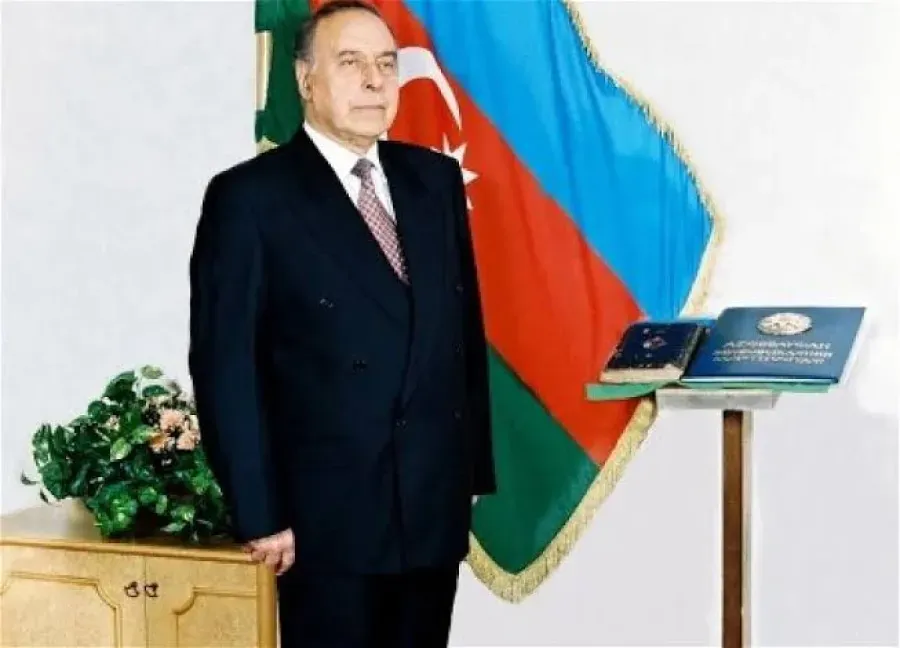
Heydar Aliyev's return to the country's leadership in 1993 at the people's demand, and his efforts to stabilise state authority, prevent armed confrontation, restore governance and strengthen independent state institutions, also marked the salvation and revival of our tricolour flag. The Great Leader, an outstanding statesman who had successfully overcome hundreds of trials throughout his political life and never bowed, respectfully bowed only before our Sacred Flag after taking the oath on the Constitution and the Holy Quran, kissing it with his entire being.
Heydar Aliyev's attitude towards the Azerbaijani flag was not limited to state protocol. His reverence for it strengthened its moral significance as a national symbol in public and political life. The spread of respect for the state flag from government buildings to schools, higher education institutions, military units, sports arenas and the everyday lives of citizens played an important role in consolidating the consciousness of independence. The state flag does not belong to any political party, ruling group or individual. It is the common heritage of the entire Azerbaijani people. Respect for it is respect for the state, independence and the sovereign will of the nation.
Under President Ilham Aliyev's leadership, a new relationship emerged between the international standing of Azerbaijan's flag and the country's actual capabilities. Growing economic strength, the implementation of strategic energy and transport projects, the modernisation of the army and the expansion of international diplomatic activity enhanced Azerbaijan's political influence. Our flag began to feature more prominently at international summits, economic forums and major sporting and cultural events. President Ilham Aliyev's 2007 decree on the establishment of the State Flag Square and the designation of November 9 as State Flag Day in 2009 demonstrated the importance attached to our history of statehood and national symbols.
Throughout the history of states, restoring a people's self-confidence following military and political defeat has been of particular importance. The path taken by the Federal Republic of Germany after the Second World War provides an interesting example. Under the leadership of Konrad Adenauer, the country's economic and political reconstruction involved establishing democratic state institutions, gaining international trust and uniting society around a new national identity. West Germany's victory at the 1954 FIFA World Cup gave German society a tremendous moral boost. The triumph, which went down in history as the “Miracle of Bern”, is regarded as an important milestone in restoring the self-confidence of post-war Germany. The significance of such achievements cannot be measured solely by sporting results. Victories on the international stage, the raising of a national flag and the playing of a national anthem can strengthen a society's confidence in its country. Over the years, Azerbaijan has also experienced various examples of this moral uplift through international sporting, cultural and diplomatic achievements. However, we faced an even greater and more historic task: to return the state flag to lands lost in war, overcome the consequences of national defeat and restore the country's territorial integrity.
The Patriotic War, which began on September 27, 2020, marked a new chapter in the history of Azerbaijan's flag. As our army advanced into territories that had remained under occupation for nearly three decades, our tricolour flag returned with it. Every day of the sacred struggle revealed the war's deeper meaning as our glorious army and soldiers carried the Azerbaijani flag into every liberated village, settlement and mountain peak. Flying in Jabrayil, Fuzuli, Zangilan, Gubadli, Hadrut and other liberated territories, our flag symbolised the restoration of Azerbaijan's sovereignty over those lands, like a symbol planted along the path taken by our ancestors and carried to the summit. At every height liberated from occupation, Azerbaijani soldiers raised the state flag as the seal of sovereignty.
Every day of the 44-day war created its own flag-related images in our national memory. As messages from the Supreme Commander-in-Chief announcing the liberation of cities and villages were broadcast, people took to the streets carrying flags and hung the tricolour from their windows, balconies and cars. The flag raised by Azerbaijani soldiers at the front became a source of joy for millions of people on the home front. During those days, the state flag was not merely a symbol of military formations; it represented the shared will, mobilisation and confidence in victory of the entire nation. On one side stood the soldier raising the flag on a liberated height; on the other were citizens shedding tears of joy as they watched the footage. The glorious Victory of 2020 was also the return march of Azerbaijani flags to the territories liberated from occupation.
The flag raised by one soldier on a liberated summit became a symbol of state honour when another soldier was laid to rest. The tricolour draped over the coffins of our martyrs and later respectfully handed over to their families is among the most moving images engraved in our national memory. Just as the colours of the Victory Flag embody the historical ideals of our state, its meaning in the post-war period carries the blood of our martyrs, the sacrifices of our veterans and the Azerbaijani people's three-decade-long struggle.
With the liberation of Shusha on November 8, 2020, the aspirations of the Great Leader and the leaders who had fought for our lands throughout centuries of history were fulfilled, and our flag reached its highest moral summit. When Karabakh was occupied, our culture, music and poetry also bore the scars of aggression. Today, however, as the Shusha summit has elevated our state and nation to the heights of their geographical and spiritual stature, there is only one force above it – the flag of Azerbaijan!
The calendar of victory was written in November. Victory Day and State Flag Day came together in the same month, united by a common meaning and sequence, marking a new political and spiritual turning point in more than a century of Azerbaijani statehood. The flag of victory now carries a distinct meaning throughout the world.
The restoration of Azerbaijan's sovereignty over its entire territory following the military operations of September 2023, and President Ilham Aliyev's raising of the state flag in the central square of Khankendi on October 15, marked a new stage in this historic process. In a city where Azerbaijan's flag had once been lowered and the symbols of a separatist entity raised, the tricolour of our state was now flying. The military parade held in Khankendi on November 8 of that year became a new page in Azerbaijan's history of statehood. Azerbaijani soldiers marched ceremoniously under their national flag in a city that had been one of the most important political centres of the conflict lasting more than three decades. The scene required no further explanation. The parade held by our army in Khankendi, the tricolour flags flying there and the Supreme Commander-in-Chief's address to the nation from the liberated lands confirmed the restoration of unified state authority throughout the country.
Sacrificing one's life for the state flag is the highest example of selflessness. However, respect for the flag is not limited to giving one's life for it. Living for the future of the state, working conscientiously and strengthening our country in every sphere of public life are also forms of patriotism. A young person raising Azerbaijan's flag at international academic competitions, an athlete winning a world championship, a diplomat defending national interests in international negotiations, an engineer bringing new technologies to our country and a teacher training highly qualified professionals all serve to enhance the prestige of our state.
Our tricolour flag, with a history spanning more than a century, is now experiencing its greatest era of victory. Its story brings together the aspirations for independence of the founders of the republic, the bitter defeat of 1920, the severe political restrictions of the Soviet period, the struggle for freedom in the 1990s, the salvation of our statehood, years of occupation, the heroism of the 44-day Patriotic War and the restoration of sovereignty in Khankendi.
The task of future generations will be to build an even stronger, more prosperous and more just Azerbaijan upon the foundation of that Victory.
Ensuring that our flag is never lowered again depends not only on our glorious army but also on every Azerbaijani citizen. That is why every citizen must hold our tricolour flag high.
For the first time in the history of Azerbaijan's independence, Shusha and our State Flag have become the benchmark of greatness!
Zahid Oruj
Chairman of the Milli Majlis Committee on Human Rights
Specially for TodayPress TV.