
Who was Yeghishe Charents, the Armenian Bolshevik to whom Iran’s mullahs pledged allegiance at the Blue Mosque?
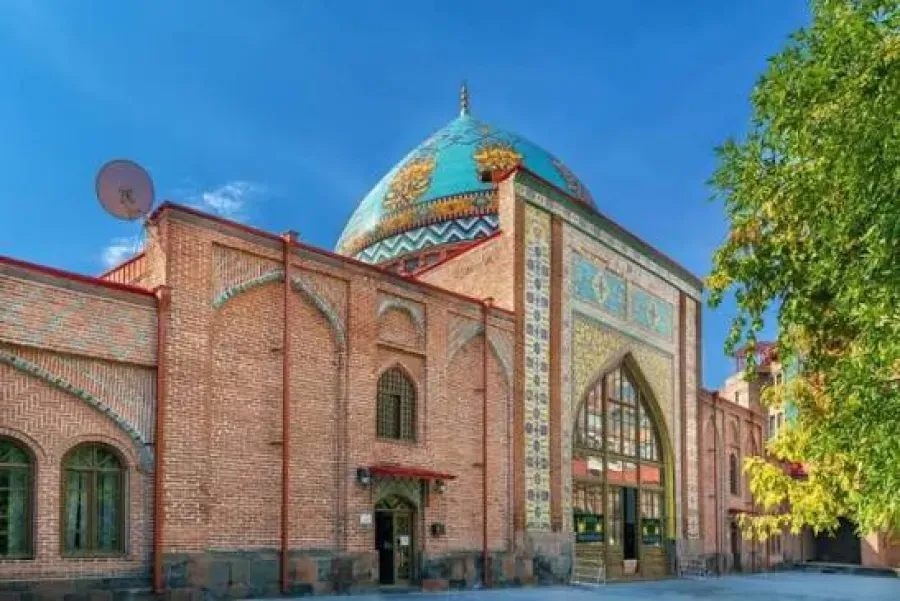
Although the plan to name the ceremonial hall of the historic Blue Mosque in Yerevan after Armenian poet Yeghishe Charents and install a bust of him there has been presented in news reports as a routine cultural event, a closer look behind the scenes reveals a series of ironic and contradictory developments. The plaque, unveiled in the personal presence of Iran’s Vice-President Seyed Hamid Pourmohammadi, in fact highlights the peculiar clash between religious principles, historical realities and political interests.
The first and most significant contradiction concerns the principles of Islam itself. A senior Iranian official, representing a country that presents itself to the world as a theocratic state governed by Sharia law, has endorsed an initiative to install a human bust inside a mosque complex. Yet Islamic tradition categorically rejects the placement of statues and busts depicting living beings in places of worship and mosque courtyards. Apparently, when it comes to demonstrating a common political stance against Azerbaijan, even Tehran’s most fundamental religious precepts can take a back seat.
Another ironic aspect of the matter is the identity of the person after whom the mosque hall is to be named. Who was Yeghishe Charents? He was an atheist Bolshevik poet who fervently glorified the Soviet Revolution and held an uncompromisingly hostile attitude towards religion and places of worship. In a bitter twist of history, the very Soviet ideology represented by Charents led to the destruction of dozens of historic mosques in Yerevan during the 1920s and 1930s, turning places of worship into warehouses and clubs.
Today, naming a hall in the only Azerbaijani mosque to have survived from that period after an anti-religious Bolshevik poet is neither logical nor compatible with historical justice. Moreover, Charents’s own fate adds another layer of paradox to the story: the poet whom Yerevan officials now present as a “symbol of friendship” was arrested in 1937 following denunciations by his own compatriots – Armenian officials – tortured to death in a Yerevan prison, and buried in an undisclosed location.
In reality, what is happening is not an isolated cultural initiative but another stage in a systematic policy pursued for years to erase Azerbaijani traces from Yerevan. Built in 1766 by Hussein Ali Khan, the ruler of the Iravan Khanate, the Blue Mosque is one of the most magnificent examples of Azerbaijani Turkic architecture in the city.
For years, Tehran and Yerevan have sought to portray the monument as a “Persian mosque”, obscuring its Azerbaijani Turkic origins. Now, the two sides appear to be resorting to a new approach. By filling the mosque’s interior with the name and bust of an Armenian poet, they seek to gradually alter the monument’s identity and present it to the world as part of a shared “Iranian-Armenian cultural heritage”.
The timing of this move is no coincidence. It comes as Azerbaijan has fully restored its territorial integrity and sovereignty, and safeguarding Western Azerbaijan’s heritage has become a matter of state policy. Wary of Baku’s legitimate historical claims, the parties involved are attempting to conceal what is described as Azerbaijan’s last remaining footprint in Yerevan behind a fabricated cultural narrative.
Yet neither a foreign plaque installed in a mosque hall nor a bust placed there in defiance of religious principles can change the true origins or historical memory of the monument erected by Hussein Ali Khan in the 18th century.
Aziz Alibayli
International affairs expert