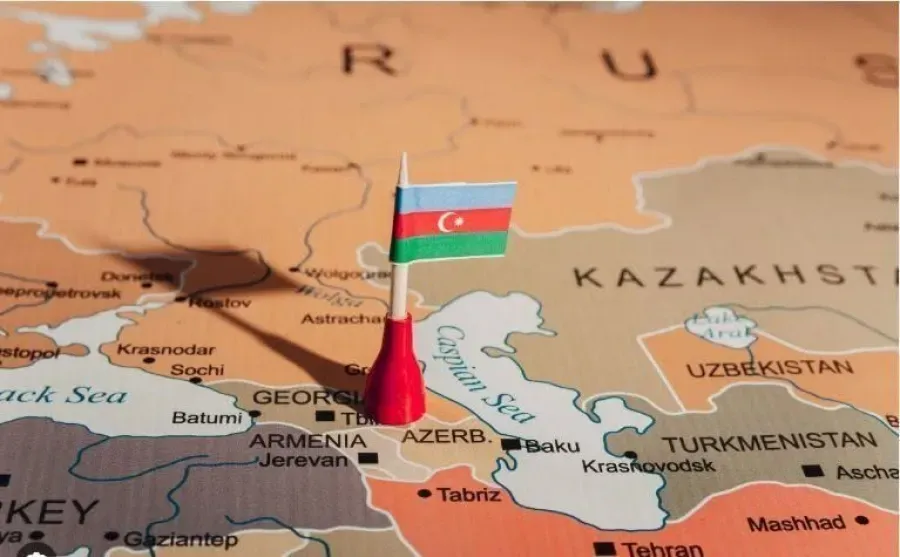

FOR THE FIRST TIME IN HISTORY: Russia has become this dependent on Azerbaijan
Alliances, statements and regimes are temporary, while geography and strategic dependencies are more enduring.
The sharp shift in the dynamics of Russia-Azerbaijan relations in recent days, along with remarks made by Russian President Vladimir Putin at the Valdai International Discussion Club, has brought a new reality on the geopolitical map of the South Caucasus to the fore.
The uproar surrounding the phrase “Russia will take Azerbaijani territory,” which emerged in opposition media in Azerbaijan, was in fact an incomplete reflection of a much larger geoeconomic picture. At a time when the world and the region are being reshaped, understanding Russia’s strategic need for Azerbaijan requires looking at the point where geography, history and economic imperatives intersect.
Russia’s dependence on Azerbaijan in its southern direction is not solely a product of the geopolitical conjuncture of recent years. To a large extent, it is a reality created by the physical geography of Eurasia. The Greater Caucasus Mountains, which separate the East European Plain from the Middle East and South Asia, serve as a natural barrier. One of Moscow’s main routes for crossing this barrier and reaching Iran, the Persian Gulf and India by land runs through Georgia via the Darial Gorge and from there toward Iran. However, the rugged mountainous terrain, restrictions caused by snow and avalanches during the winter months, as well as Georgia’s Western-oriented policy limit the potential of this route for Russia.
The other route is the Caspian corridor. Passing through Derbent and along the Samur River into Azerbaijan, and from Baku toward Iran via Astara, this route provides a more favorable geographical passage. The flat terrain along the Caspian coast offers more suitable opportunities for both road and rail transportation.
It is precisely this geographical advantage that makes Azerbaijan an important transit link for Russia’s access to the south.
Following the Treaties of Gulistan and Turkmenchay in the 19th century, the Baku-Astara route played an important role in the expanding economic ties of the Russian Empire with the South Caucasus and Iran.
During 1941-1945, a significant portion of the military and logistical assistance sent to the Soviet Union by the United States and the United Kingdom was transported through Iran. The shipments reached other parts of the Soviet Union via the Astara and Baku routes. Known to history as the “Persian Corridor,” this route became one of the important supply lines used by the Soviet Union during the war years. This fact also shows that Baku and the territory of Azerbaijan have held particular importance for Russia’s access to the south not only in today’s geopolitics but in earlier periods as well.
In the modern era, economic and political imperatives have been added to this geographical factor. Since 2022, the Russia-Ukraine war and the wide-ranging sanctions imposed by the West have seriously restricted Moscow’s previous logistics and trade routes. For Russia, turning toward the south and east has become an important part of its economic strategy.
Access to India, Iran, the Persian Gulf countries and broader Asian markets is of particular importance to Moscow. The International North-South Transport Corridor has come to the forefront precisely as a result of this need. Although cargo transportation across the Caspian Sea is possible, completing railway connections is particularly important for large-scale and rapid freight transportation. In this regard, the route through Azerbaijan remains one of Russia’s main land connections for accessing southern markets.
This point is crucial to understanding the essence of the remarks made by Vladimir Putin at the Valdai Discussion Club. The Russian leader said that Moscow was ready to allocate the necessary credit resources for completing the land section of the North-South project. Putin also emphasized that he was in close contact with Azerbaijani President Ilham Aliyev, that there were no problems with Baku on this issue, and that Azerbaijan fully supported the project.
However, part of the speech led to different interpretations in Azerbaijan, particularly on social media.
Some people fail to understand that this process brings significant dividends to our country. The section in question, which is an important part of the North-South corridor, is approximately 160 kilometers long. The construction of the railway requires the purchase of privately owned land along the route and the establishment of construction zones. Russia allocated a €1.6 billion loan to Iran to finance the project. However, delays in land acquisition and other procedures in Iran are affecting the implementation of the project. This was precisely the problem Putin was referring to in his remarks.
In general, within international transport projects, the long-term leasing or joint operation of logistics terminals, loading and unloading facilities and various infrastructure facilities is not an unusual practice. In different countries around the world, ports and logistics hubs are operated with the participation of foreign companies and international operators. The participation of a Chinese company in Greece’s Port of Piraeus, as well as the activities of international operators at global transport hubs such as the Suez Canal and Rotterdam, demonstrate how widespread this model is.
Does a commercial relationship mean a change in sovereignty over territory? Transit fees, service charges and other revenues generated from infrastructure provide the state with economic benefits.
All of this indicates that a new geoeconomic reality is taking shape in the South Caucasus. For Russia, Azerbaijan is not merely an important neighbor in political and security terms. Baku has become an important transit link for Moscow’s access to southern markets. This, in turn, is changing the nature of mutual dependence in relations between the two countries.
In the past, Moscow primarily relied on influence based on military and political superiority in its relations with South Caucasus countries. At the current stage, however, economic and logistical interests have also become important factors shaping Russia’s behavior. Azerbaijan, meanwhile, occupies a special position in the regional transit system by being located simultaneously along both the North-South route and the East-West route, namely the Middle Corridor.
For Baku, the main task is to turn this geographical advantage into political and economic dividends. On the one hand, Azerbaijan keeps transit opportunities vital to Russia open within the framework of its sovereignty; on the other, it maintains its role in Europe’s energy security and participates in the development of the Middle Corridor. Thus, the country is becoming a transport and energy hub connecting several directions at once.
The North-South corridor is an important element of economic relations between Russia, Azerbaijan, Iran and, in a broader sense, Asia and Europe. Azerbaijan’s geographical position, meanwhile, gives Baku significant diplomatic and economic opportunities within this system.
Russia is interested in using the route to Iran and southern markets. This means that Russia needs Azerbaijan and that Moscow is, to a certain extent, dependent on Baku in this regard. So why not view the process as transit diplomacy that strengthens Azerbaijan’s regional geopolitical weight? Despite some narratives aimed at creating chaos, as President Ilham Aliyev has repeatedly emphasized, Azerbaijan knows well what it needs to do, when to do it and under what conditions.
Jala Rovshan