There is a mountain on Mars that makes Everest look tiny
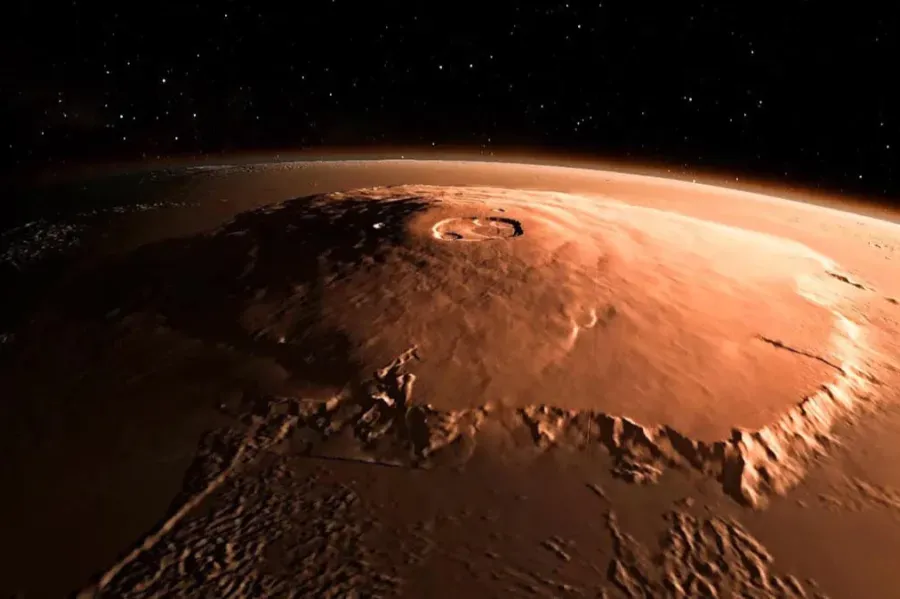
Mount Olympus on Mars is one of the largest volcanoes in the Solar System. It reaches a height of 21,900 metres, making it approximately 2.5 times taller than Mount Everest, the highest peak on Earth.
TodayPress TV reports that the publication Futura wrote about this, citing data obtained by the European Space Agency’s (ESA) Mars Express spacecraft.
Known by its Latin name, Olympus Mons, the giant volcano has a base diameter of approximately 600 kilometres. This gives an idea of its enormous scale. At its summit is a massive caldera measuring 25 kilometres in diameter and 3 kilometres in depth.
Mount Olympus is classified as a shield volcano. Such volcanoes form over long periods as successive layers of fluid basaltic lava accumulate. As a result, its slopes have an average gradient of just 5%.
According to scientists’ estimates, the volcano began forming approximately 3.5 billion years ago. The youngest lava flows are believed to date back around 2 million years. Although no active eruptions have been recorded at present, some tremors observed in the region suggest that geological processes may still be occurring deep within the volcano.
Another interesting discovery related to Mount Olympus was made in 2024. A team led by Adomas Valantinas, a researcher at Brown University, discovered water frost on the slopes of volcanoes in Mars’s equatorial region, including Mount Olympus.
Previously, the presence of such ice deposits in these areas was considered unlikely because of intense solar radiation and the thin Martian atmosphere. However, researchers found that a layer of dust protects the ice deposits.
The discovery is also significant for future crewed missions to Mars. The presence of water on the planet’s surface, even in the form of frost, broadens the prospects for future research and the potential use of local resources.
Kubra Musayeva