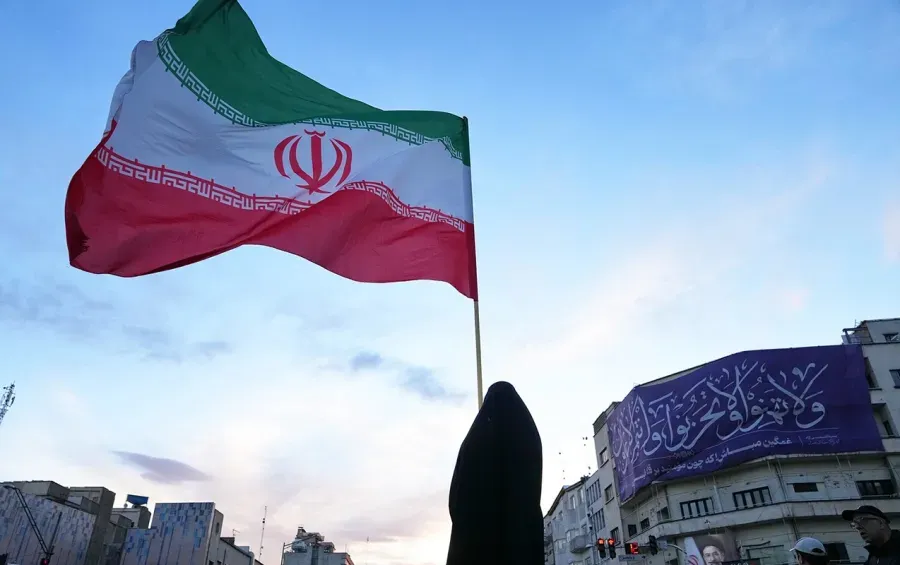

Was the Iranian flag raised in Borchali? – They erased our lands from the map
Whom does the national rhetoric of Marneuli’s Friday prayer leader serve, and who should have been the real target of the stone thrown at the wrong address by Mubariz Ahmadoglu?
Two voices in the same week
In the final days of November, two issues concerning Borchali dominated the media space of Azerbaijanis in Azerbaijan and Georgia. The first was a speech by political analyst Mubariz Ahmadoglu that circulated on social media. He accused Azerbaijanis in Borchali of failing to protest the fate of the Blue Mosque in Yerevan and declared: “Shame on the men living in Borchali.” His remarks provoked a strong reaction in the region and in Baku.
The second issue came from Marneuli on November 20. Haji Hajiyev, the cleric leading Friday prayers at the Hazrat Imam Ali Central Mosque in Marneuli, accused the city administration of inaction in his Friday sermon. He spoke about deteriorating roads, the sewerage system that had remained unfinished for years, and the conditions in the villages of Gullar and Jandar. The most widely circulated line from his sermon was:
“What is this nation’s sin? Is it being Muslim, being Azerbaijani? What is this nation guilty of?”
Putting these two issues side by side reveals an interesting picture. On one side stands a political analyst accusing Borchali of indifference to a national issue. On the other is a religious figure repeatedly using the words “nation” and “Azerbaijani” from the pulpit. The question lies between these two voices: who speaks in the name of the national cause in Borchali, and on which national issue does that person remain silent?
Ahmadoglu’s stone and Borchali’s response
The reaction to Mubariz Ahmadoglu’s remarks was swift. In a statement circulated under the signature of Ramiz Hasanov, chairman of the Borchali Society Public Union, the phrase “Shame on the men living in Borchali” was condemned. The statement stressed that judging the men of an entire community based on the position of a few individuals was insulting and called on the political analyst to apologise. Ali Babayev issued an ultimatum demanding an apology, warning that otherwise he would take the matter to court. According to Babayev, if there were suspicions concerning particular individuals, their names and specific evidence should be provided. Ilgar Ilkin published a sharply worded response in Axar.az, while Musa Nabioglu did the same in Tezadlar.az.
This reaction is justified. It is unfair and serves no one to collectively accuse the men of Borchali, who have remained in their homeland despite the most difficult challenges since the late 1980s and helped preserve the Azerbaijani presence in Georgia. Ahmadoglu’s mistake lay in his approach and in directing his accusation at the wrong people. However, the question he raised is valid and deserves an answer: why was there no public response from Borchali regarding the Blue Mosque?
It is unfair to expect an answer to this question from a Borchali farmer, merchant, teacher or young person who has gone to Russia or Türkiye to support their family. There are pulpits in the region that exert considerable influence over public opinion. There are religious figures who address thousands of people every Friday and consider it their duty to speak on behalf of the “nation”. The question should be directed at them.
What happened at the Blue Mosque?
On November 11, the Caucasus Muslims Board and the State Committee for Work with Religious Organisations issued separate statements protesting developments at the Blue Mosque in Yerevan. The proposal was to name the mosque’s ceremonial hall after Armenian poet Yeghishe Charents and install a bust of him there. The Caucasus Muslims Board described the initiative as vandalism and provocation incompatible with Muslim religious ceremonies. The State Committee said the attempts were aimed at pushing the Blue Mosque’s historical and cultural identity into the background and presenting the monument as belonging to another culture.
The Blue Mosque was built between 1760 and 1766, during the reign of Hussein Ali Khan, the ruler of the Iravan Khanate, and was once considered the largest mosque in the Caucasus. It is the last major monument reminding people that Yerevan was an Azerbaijani city.
The second aspect of the issue receives far less attention. On December 10, 2015, the Armenian government adopted a decision granting the Blue Mosque and its grounds to the Iranian Embassy in Armenia, free of charge, for a period of 99 years, to be used as a cultural centre. The mosque’s restoration in the 1990s was also carried out with Iranian funding. In a video published in early November this year on the official social media account of Iran’s Embassy in Armenia, the Blue Mosque was presented as an example of Iran’s cultural heritage.
In other words, the “Armenianisation” of Azerbaijani heritage is taking place in a building managed by Tehran, against a backdrop of Tehran’s silence. The struggle over the identity of this monument is being waged on two fronts: against Armenian distortion and Iranian appropriation.
Tehran’s “Islamic solidarity” in Yerevan
Iran’s position on the Blue Mosque is a continuation of its policy towards Armenia. Tehran presents itself as the protector of all Shiites and Muslims around the world. Yet, for thirty years, Iran’s voice was barely heard regarding the mosques destroyed and desecrated in Karabakh during the Armenian occupation. The conversion of the Juma Mosque in Aghdam into a barn and the reduction of mosques in Shusha, Zangilan and Fuzuli to ruins did not feature on Tehran’s agenda of “Islamic solidarity”.
On the contrary, Iran expanded its political and economic ties with Armenia throughout those years. After the 2020 Patriotic War, Tehran opposed the Zangezur Corridor, which envisaged a land connection between Azerbaijan and Nakhchivan, and declared any change to regional borders a “red line”. In October 2022, Iran opened a consulate general in the Armenian city of Kapan. The Blue Mosque is also a cultural showcase for this policy: by presenting an Azerbaijani monument as “Iranian heritage”, Tehran is consolidating its presence in Yerevan.
Against this backdrop, the silence of religious figures linked to Iran’s influence network on the Blue Mosque issue appears consistent. They remain silent where Tehran is silent and speak where Tehran speaks. Pulpits that speak about Palestine, Lebanon and Yemen fall silent when it comes to the fate of an Azerbaijani mosque in neighbouring Yerevan.
There was no place for the Blue Mosque on Marneuli’s pulpit
Haji Hajiyev’s November 20 sermon was delivered nine days after the provocation at the Blue Mosque. The word “nation” was repeated several times in the sermon, the question “Is it a sin that we are Azerbaijani?” was raised, and “the road to God’s house” was mentioned. But the Blue Mosque was absent. It was not possible to find even a single public statement by the Friday prayer leader about what had happened to the house of God in Yerevan.
In Baku, the Caucasus Muslims Board, the State Committee, intellectuals, MPs and even poets spoke out on the issue. Meanwhile, Marneuli’s pulpit, which speaks so frequently about the “nation”, was concerned with the asphalt road leading to the house of God.
The selective nature of this sensitivity is clear. National sentiment is invoked when it is needed to challenge the local authorities in Georgia. When the target is the mayor’s office, the municipal assembly or local councillors, the question “Is it a sin that we are Azerbaijani?” is heard from the pulpit. But when a national issue touches Iran’s interests, that sentiment falls silent. When Azerbaijani heritage is being renamed after an Armenian poet in a building leased to Tehran, no voice is heard from Marneuli.
This is precisely where Mubariz Ahmadoglu’s stone should have landed.
Trading in the national cause
This selectivity does not appear to be accidental. Haji Hajiyev is a well-known figure in Georgia’s religious life, and his speeches receive wide circulation. He is capable of saying the right things when necessary. In November 2025, he condemned in his sermon ethnically motivated violence against Azerbaijani youths from Dmanisi and Karachop in Tbilisi. He offered condolences for the servicemen killed in the crash of a Turkish military aircraft on Georgian territory. He also spoke at a memorial ceremony for the late ambassador Dursun Hasanov.
All these statements are moments that attract public attention and help establish the Friday prayer leader’s image as a religious figure with a “national stance”. The Blue Mosque, however, is an issue that requires a choice. Speaking out on it would have meant opposing Tehran’s position.
The logic behind this choice becomes clearer when one looks at Hajiyev’s circle. According to reports published in the Georgian Azerbaijani media, Haji Hajiyev attended a religious event in Marneuli organised by the Georgian Centre for Islamic Studies, alongside Haji Hasan Yusifzadeh, Georgia representative of Iran’s Al-Mustafa International University. In December 2020, the US Department of the Treasury placed Al-Mustafa International University on its sanctions list, accusing it of recruiting personnel for the Islamic Revolutionary Guard Corps’ Quds Force. In mid-November, the pro-Iranian Shafaqna news agency described Hajiyev as the preacher at a mourning ceremony for Hazrat Fatima at the Ahl al-Bayt Mosque in Tbilisi.
None of these activities, taken individually, constitutes a crime. A religious figure may attend religious events and deliver sermons at religious ceremonies. However, when one examines where the rhetoric of “national identity” is invoked and where it falls silent against this background, the overall picture becomes clearer. National sentiment is being used as a currency: deploying it against local authorities earns the Friday prayer leader influence, while deploying it against Tehran’s interests would put the very source of that influence at risk.
Tehran’s familiar playbook
Iran’s method of operating among Shiite communities has been known for years. First, a sense of victimhood is cultivated within the community. The local state is then presented as the cause of that victimhood. Next, the mosque is positioned as the community’s sole defender and spokesperson. In the final stage, the resulting social base becomes a political lever for Tehran.
The sequence in Hajiyev’s sermon fits this pattern. The speech begins with roads and sewerage, moves on to the question “What will you answer to God on Judgement Day?” and ends with “Is it a sin that we are Muslim, that we are Azerbaijani?” Municipal neglect is presented as religious and ethnic discrimination. The congregation is then given an instruction: “Let 10 or 15 people go and demand a meeting.” The mosque is the organising centre.
As far back as 2005, the Institute for War and Peace Reporting (IWPR) wrote that although preachers arriving from Iran officially came to teach Persian and Islam, their main target was the Azerbaijani population of Kvemo Kartli, and that political intentions were concealed behind charitable activities. Over the past twenty years, this process has deepened. In March this year, Radio Free Europe/Radio Liberty wrote that Iran’s influence in Georgia had grown under the Georgian Dream government and that pro-Iranian sentiment was also evident in Kvemo Kartli.
Tehran’s interest in Borchali is not limited to the religious sphere. In September this year, a map shared by Iran’s ambassador to Georgia, Ali Mojani, attracted attention because it omitted the eastern part of Georgia, where Azerbaijanis live in large numbers. Experts interpreted this as a message suggesting that these territories had once been part of Iran. Tehran, which calls the Blue Mosque “Iranian heritage”, also views Borchali as part of its own historical “heritage”.
Azerbaijan has seen the consequences of this playbook in its own experience. In 2015, a process that began in Nardaran with religious slogans and social discontent escalated into an armed confrontation. In 2018, Yunus Safarov, who had arrived from Russia, attempted to assassinate the head of the executive authority in Ganja. Azerbaijani law enforcement agencies have repeatedly stated that the Husseiniyun group, formed in Syria under Iran’s patronage, was recruiting Azerbaijanis.
Who pays the price for this trade?
Ultimately, it is the Azerbaijani population of Borchali that pays the price for this trade in the national cause.
First, relations with Tbilisi suffer. When the Georgian state and society see an Azerbaijani community being mobilised through a mosque and demands directed at local authorities being voiced from the pulpit, they view the situation through the prism of Iranian influence. The image of Azerbaijani citizens who have spent years building a secular, state-loyal community supportive of Georgia’s European orientation is undermined. Observers have already noted an increase in hate speech targeting Azerbaijanis on Georgian social media.
Second, ties with Baku weaken. The difference between the Caucasus Muslims Board and the pulpit in Marneuli over the Blue Mosque issue is symbolic. When Baku defends Azerbaijani heritage but Marneuli’s most influential pulpit remains silent, this reveals the direction taken by Borchali’s religious leadership. This is also one reason why people such as Mubariz Ahmadoglu end up accusing all of Borchali: the silence of the pulpit is perceived as the silence of the people.
Third, Borchali’s real problems remain unresolved. Roads, sewerage and village infrastructure are indeed in a dire state. As these problems are shifted onto the plane of religious and ethnic confrontation, resolving them becomes more difficult. Local authorities begin looking for signs of foreign influence behind such demands.
Aziz Aliyev
International affairs expert