
Curfew-bound democracy in France: Social unrest and the political crisis of Macron’s government
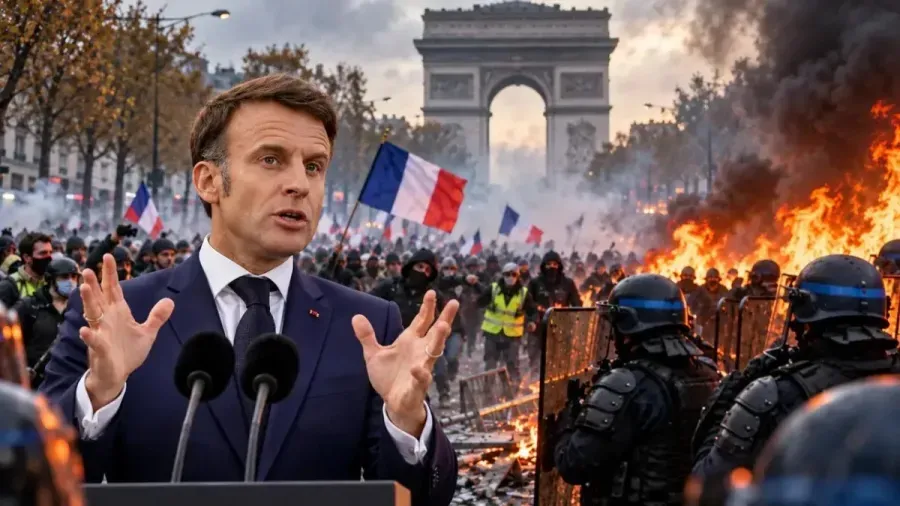
France, a country whose revolutionary history helped bring down monarchies and reshape Europe, is once again witnessing unrest around the Élysée Palace, with protests continuing to spread to other regions. Mass demonstrations across French streets have turned the final phase of Emmanuel Macron’s presidency into one of the country’s most complex political periods. Protests stretching from Paris to Marseille and from Lyon to Bordeaux, clashes with police, thousands of arrests and attacks on public buildings reflect years of accumulated discontent between citizens and the authorities. The gap is widening between France’s international standing, economic capacity and historically powerful state institutions, on the one hand, and people’s everyday living conditions, on the other.
In September 2026, demonstrations initially led by students protesting teacher shortages, overcrowded classrooms, deteriorating school facilities and budget constraints quickly developed into a nationwide movement of discontent. Teachers, parents, trade unions, civil society organisations and various political groups joined the students. Initially focused on problems in the education system, the demands gradually expanded to include the cost of living, wages, social protection and the government’s economic policies. According to figures from the French Interior Ministry, 266,000 people took part in demonstrations on October 6, while organisers put the figure at 450,000. On October 17, around 110 marches took place nationwide. Police estimated the turnout at 550,000, while organisers claimed 800,000 participants.
In Paris, Marseille, Lyon, Bordeaux and Limoges, cars were set on fire, shops were looted and public buildings were attacked. A fire at Limoges’ historic town hall attracted widespread attention. More than 2,400 people were detained during the events of October 17 and the subsequent unrest. The total number of detentions across various stages of the latest wave of protests approached 8,000.
The unrest in France has deep historical roots. Despite visible differences between today’s demonstrations and the famous Yellow Vest movement that began in November 2018, their social origins are similar. At the time, an increase in fuel taxes triggered the initial protests. But the people who took to the streets wearing the yellow safety vests they kept in their cars were expressing broader grievances: those who relied on private vehicles to commute to work and spent much of their income on transport and utility bills felt that the government was failing to take their problems seriously.
On December 8, 2018, approximately 125,000 people demonstrated in various French cities, and more than 1,700 people were reportedly detained that day. Clashes between police and protesters in central Paris, burning cars and damaged shops became major international news. In 2023, the decision to raise the retirement age from 62 to 64 once again triggered street protests and physical confrontations.
Official statistics provide a clearer picture of the economic foundations of public discontent in France. According to figures released by the National Institute of Statistics and Economic Studies (INSEE) in July 2026, 9.8 million people living in ordinary households in metropolitan France were below the poverty line in 2024. The poverty rate reached 15.4%, the highest level in comparable calculations dating back to 1996. The monthly poverty threshold was set at €1,337 for a single-person household. Unemployed people and single-parent families are among those facing particularly difficult social conditions.
The labour market is also contributing to public concern. In the second quarter of 2026, France’s unemployment rate rose to 8.3%, with the number of unemployed reaching 2.7 million. The number of unemployed people increased by 261,000 over the course of a year.
The rising cost of living is among the most significant economic drivers of the protests. According to INSEE, annual inflation in France reached 3.1% in September 2026. However, increases in individual goods and services are more significant than the overall price index. Over one year, energy prices rose by 21.3%, petroleum products by 36.2% and diesel fuel by 44.1%. Food and service prices also increased.
The main challenge facing Macron’s government is the limited financial capacity of the state to meet social demands. France has a large economy, a broad tax base and strong state institutions. Nevertheless, financing social expenditure, weak economic growth and rising public debt have created serious problems. According to INSEE’s data for 2025, public debt reached 115.7% of gross domestic product (GDP). The budget deficit stood at €152.5 billion, or 5.1% of GDP, while public spending accounted for 57.2% of the economy.
Following the unrest, Prime Minister Sébastien Lecornu ordered the introduction of limited curfews. He instructed prefects to take firm measures to prevent further riots and looting. However, there is little doubt that such restrictions can significantly constrain the rights to assemble and protest peacefully. Those who lecture the world on democracy from Strasbourg are, through curfews, once again provoking the people, as in the past, towards an armed assault on the Bastille. Security forces are expected to intervene in demonstrations in the coming days.
A second major factor making the current crisis more complex than previous episodes is the lack of a stable parliamentary majority. Following the 2024 snap parliamentary elections, divisions among France’s political forces became more pronounced. The president’s political camp lost the ability to pass legislation on its own in the National Assembly. Significant policy differences remain between left-wing forces, the right-wing opposition and centrist parties.
Macron’s rise to power in 2017 was built around the promise of offering an alternative to the traditional dominance of France’s established right-wing and left-wing parties. However, confrontations with the opposition and trade unions have intensified over time. Critics have argued that the burden of economic policies falls disproportionately on lower- and middle-income groups.
Both far-right and far-left forces are seeking to use the current situation to advance their political objectives. Marine Le Pen’s National Rally places emphasis on security and governance, while left-wing forces represented by Jean-Luc Mélenchon criticise social inequality and police interventions.
The consequences of developments in France are also significant for Europe. France is one of the European Union’s leading political and economic powers, a permanent member of the UN Security Council and an important player in European security policy. Protests in Tirana, Lisbon and Milan reflect concerns that share some common causes. Moreover, because Paris is a key participant in European defence policy, support for Ukraine, industrial competitiveness and energy security, the ongoing crisis is intensifying resistance to its current policy commitments.
As for the possible impact of events in France on Azerbaijan, tensions between the two countries have remained unresolved in recent years. Under Macron, disagreements over the outcome of the Karabakh conflict, what the article describes as a hybrid campaign against Azerbaijan following the 2020 war, controversial resolutions adopted by the French National Assembly, the Élysée’s confrontational approach in the European Parliament and defence cooperation with Armenia have all contributed to strained relations. Paris’s publicly stated approach to the peace process in Yerevan, which the author contrasts with what he describes as a different policy pursued behind the scenes, has further exposed the crisis. These developments, the article argues, show that the current administration has failed to formulate an effective domestic and foreign policy.
Before Macron came to power, Azerbaijan–France relations had developed successfully. During the presidency of national leader Heydar Aliyev, cooperation with Paris was an important part of Azerbaijan’s foreign policy, and political, economic and cultural ties expanded. In the early years of his presidency, Ilham Aliyev also attached particular importance to broadening relations with France. The current tensions are damaging cooperation opportunities that the two countries built over many years. According to information updated by the French Ministry for Europe and Foreign Affairs in September 2026, French exports to Azerbaijan reached €311.2 million in 2025, although the potential for trade is considerably greater.
France’s domestic political crisis is likely to affect its international role. Cooperation with Armenia and its interests in the South Caucasus cannot advance under the current administration’s approach, the author argues.
Azerbaijan is not waiting to see which political force prevails in France’s domestic confrontation. Its interest lies in ensuring that relations with France are based on respect for state sovereignty, territorial integrity and mutual respect. In particular, the Washington agreements of August 8, 2025, have created opportunities for a new regional relationship. Paris could contribute to consolidating peace through economic cooperation, transport links and diplomatic dialogue.
A second important implication of the French crisis for Azerbaijan concerns the wider state of the European economy. The European Union is a key partner for Azerbaijan’s energy exports, trade relations and transport routes. Prolonged economic weakness in a major economy such as France could have some impact on Europe’s investment climate, energy demand and financial markets.
The broader lesson from France’s current situation is clear. Even in a country with strong state institutions, considerable economic resources and an extensive social protection system, millions of people continue to express dissatisfaction with incomes, employment, education and living costs. It would also be an oversimplification to attribute the causes of street protests solely to the activities of radical groups.
The final phase of Macron’s presidency has exposed a crisis involving France’s social model, parliamentary system and economic reforms, accompanied by political turmoil and physical confrontations. This demonstrates that European institutions are facing new challenges.
However, the prospect of forces that respond to the interests of the people coming to power could, the author warns, be accompanied by the rise of radical or even fascist-leaning parties, as in Germany. The revolutionary movement that began in Paris may therefore continue to spread geographically.
Government resignations are inevitable.
Zahid Oruj
Chairman of the Human Rights Committee of the Milli Majlis of Azerbaijan