
Could Russia occupy Poland in one day?
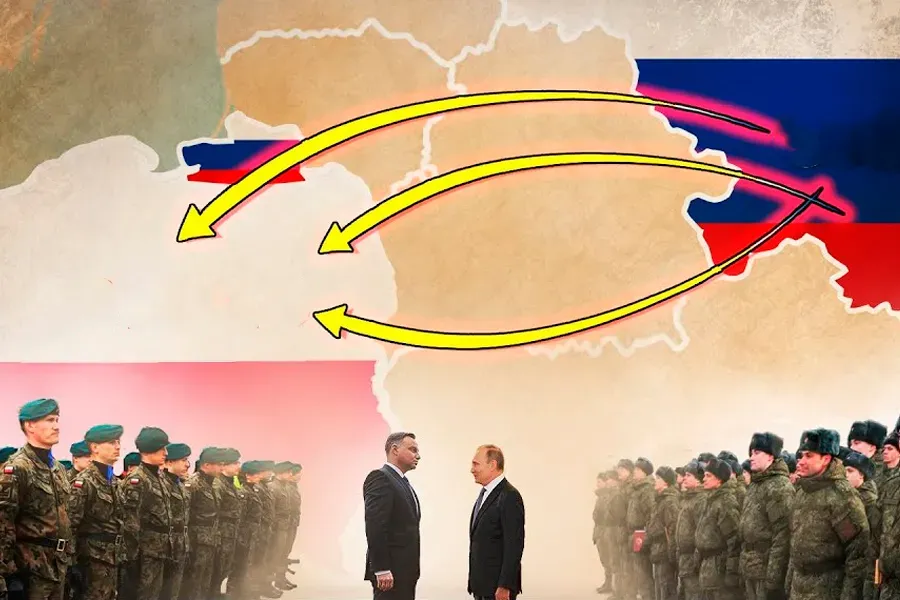
This is the overall assessment given by Russia in recent times regarding developments in Europe and the ongoing war. As it can be seen, within the context of the Russia-Ukraine war, the scenario of Poland becoming involved in the war is increasingly being discussed.
Undoubtedly, Poland is a greater power than Ukraine. Can Russia, which has been weakened and has expended its resources in the war and occupation process in Ukraine, occupy the stronger Poland within one day, as has been claimed? It should be taken into account that Russia has been a constant participant in the six or seven partitions of Poland throughout history. However, today’s realities are not the same as those of 1939: neither is Poland the same Poland, nor do Stalin and Hitler, who last partitioned Poland, exist today.
The partition of Poland has never ceased to be a subject of discussion in world history and political debates. What historical illusions has Russia’s renewed focus on the issue and references to the past stirred in Poland’s thinking, and what has this led to? This is a particularly interesting subject. However, the question of whether Russia could occupy Poland within one day remains a major subject of debate.
First of all, it should be noted that the most alarming “red line” for Poland is the events of 1939. At that time, Germany invaded Poland from the west, while the Soviet Union entered from the east, and together they partitioned the country within 35 days. Poland was attacked simultaneously from both the east and the west. The country had to fight both Nazi Germany and Soviet Russia at the same time, but this proved impossible. At that time, there was no organization such as NATO that Poland could have been a member of and that could have protected it.
It is fundamentally wrong to equate the historical circumstances of 1939 with those of the present day. During the Cold War, for example, NATO analysts stated in the 1970s and 1980s that if the Warsaw Pact attacked West Germany, it could reach the country within 72 hours. Poland was considered a corridor in that hypothetical offensive scenario because it was a member of the Warsaw Pact at the time.
From the perspective of comparative military analysis, the experience of the Russia-Ukraine war, which has continued since 2022, provides an answer to the question, “Could Russia occupy Poland in one day?” Russia was unable to occupy Ukraine and achieve a quick victory. Russia had reportedly projected that it would take Ukraine in three to seven days and Kyiv within 72 hours, but it failed to achieve this. Although Ukraine’s army was expected to collapse immediately, the opposite occurred: Ukraine built a mobile and capable military. It was also claimed that Western sanctions would have no effect, but those sanctions were not ineffective and proved partially effective.
The situation is different when considering the strength of the Polish military:
* Poland is protected by NATO’s Article 5.
* It allocates more than 4% of its GDP to defence spending.
* It possesses modern armoured equipment such as Abrams and K2 Black Panther tanks.
* It aims to increase the size of its active military to 300,000 personnel.
Although Russia has described NATO as a “paper tiger” based on various developments, the facts are different: since 1949, no NATO member has lost territory. NATO is a significant deterrent, and no one seeks to intervene in its geographical area. Article 5 creates strong psychological and strategic pressure on potential adversaries. In addition, the United States, the United Kingdom and France provide a nuclear umbrella, while NATO members prepare operations on the basis of unified plans. Even in 1939, when Poland was attacked, France and the United Kingdom declared war on Germany.
From whichever perspective it is considered, the possibility of Russia attacking NATO or taking Poland within one day is described as absurd. Such an outcome could only be possible under a global nuclear scenario, in which case at least three major nuclear powers would stand on the opposing side.
Nevertheless, the information war continues, and the thesis of “occupying Poland in one day” is presented as a geopolitical instrument of Russia. The main objectives here are:
* keeping Poland under fear and pressure;
* creating doubts among Poles that “NATO will not protect us” and undermining confidence in the alliance;
* influencing European public opinion and weakening support for Ukraine;
* reviving the myth of Russia’s military power.
This is also referred to within the framework of hybrid warfare theory as the “Gerasimov doctrine.” Such psychological messages often serve to alter the conditions of a conflict and create serious risks for the opposing side.
Geographically, Poland is also not in the same position it was in 1939. It has an area of 312,000 square kilometres, has built strong defensive fortifications against rapid tank offensives, and its major cities, particularly Warsaw, are fully prepared for defence. Although Russia is close to Poland through Kaliningrad, this also means that Russia directly borders NATO. The Belarus-Poland border is already under NATO’s full control.
Aziz Alibeyli
International Relations Researcher