
Who is concerned by diplomats’ visit to Karabakh? — A clear warning to revanchists
There are events that, in themselves, may appear to be ordinary diplomatic engagements, but in reality become a genuine litmus test. They immediately reveal who perceives the changed reality, and in what way.
The recent visit to Karabakh by a large group of representatives of the international diplomatic corps accredited to Azerbaijan, accompanied by Hikmet Hajiyev, Assistant to the President of Azerbaijan and Head of the Foreign Policy Affairs Department of the Presidential Administration, was precisely such an event.
Around 150 representatives from 58 countries and nine international organizations saw with their own eyes what for many years had been discussed primarily through diplomatic documents, statements by politicians, and propaganda materials.
They saw Karabakh as it exists today. Not on a map from twenty years ago, not through old slogans, and not through emotionally charged statements by diasporas, but on the ground.
They saw cities and villages that, after decades of destruction, are gradually returning to life. They saw the scale of reconstruction. They saw new roads, infrastructure, construction projects, and the return of Azerbaijani families to their ancestral homes. They saw a territory that, after nearly three decades of occupation, is being transformed from a symbol of war into a space of peaceful reconstruction.
And it was precisely this, judging by the reaction of certain circles in Armenia, that proved to be the most painful aspect.
Because it is one thing to debate Karabakh from a distance, and quite another when dozens of diplomats from different countries travel there and are given the opportunity to see what is happening for themselves.
This is where things become particularly interesting.
For decades, an enormous information framework existed around Karabakh. It contained everything: historical myths, political slogans, emotional campaigns, narratives of “eternal Armenia,” numerous attempts to portray the conflict exclusively through the lens of one side’s tragedy, and the almost complete exclusion from the international information space of the history of Azerbaijani refugees, destroyed Azerbaijani cities and villages, the Khojaly genocide, and other tragic chapters of the conflict.
But times have changed.
The political map has changed, the balance of power has changed, international perceptions of the South Caucasus have changed, and, most importantly, the reality on the ground itself has changed.
In 2020, the Second Karabakh War lasted 44 days and ended with the defeat of the Armenian armed forces and Azerbaijan restoring control over a significant part of its internationally recognized territories. In September 2023, a one-day military operation followed, after which Azerbaijan restored full control over its entire territory.
One may argue endlessly over the political assessments of these events, continue writing books and articles for decades, or attempt to develop new interpretations of history, but there is one thing that cannot be undone by statements.
History has changed, and now Armenia and Armenian society face the central question: are they prepared to accept this new reality?
It is precisely here that the recent visit by foreign diplomats became a genuine litmus test, because the international community is gradually doing what it always does when geopolitical realities change: it adapts
Only yesterday, many Western politicians and diplomats were extremely cautious about visiting Azerbaijan’s liberated territories. Today, foreign representatives regularly travel there, familiarize themselves with developments, examine reconstruction projects, and return to their capitals with impressions of their own.
This is neither love for Azerbaijan nor hatred of Armenia. It is called pragmatism in international politics.
International politics is rarely built on eternal love or eternal hatred. States have interests, diplomats observe reality, and politicians adjust their positions. Yesterday’s slogans gradually give way to today’s facts, and it is this evolution that appears to be increasingly irritating those in Armenia who cannot move beyond the psychological space of the past.
They would like to have a very convenient world: Azerbaijan would speak of peace, Armenia would speak of peace, the diplomatic process would continue, borders would gradually open, and communications would develop.
But at the same time, they would want the old political image of Karabakh to continue to exist in the West, the old information machinery to remain operational, and diplomats to continue viewing the South Caucasus through the eyes of the 1990s.
They would want to retain the perpetual opportunity to tell the world about “eternal Armenia,” about an allegedly unchanged political reality that supposedly existed for centuries, about a “genocide of memory,” and about “ethnic cleansing,” while virtually never mentioning the fate of hundreds of thousands of Azerbaijanis expelled from their homes, destroyed Azerbaijani settlements, the Khojaly genocide, or the tragedy of the Azerbaijani population of Karabakh.
But this no longer works, and this is perhaps the principal outcome of recent years. The monopoly over the interpretation of Karabakh’s history has ended, and there are now at least two historical memories.
There is the Azerbaijani memory of war, occupation, displacement, destroyed cities, and return to the homeland, and the Armenian memory of its own tragedy, the peaceful departure of the Armenian population of Karabakh, and the historical catastrophe it experienced.
Neither of these historical memories will disappear at the command of politicians. But if both sides genuinely want peace, they must learn to coexist not only with their own memory, but also with the memory of the other side.
This is where a genuine peace process begins.
Not with the signing of a beautiful document, not with handshakes in front of television cameras, and not even with declarations of territorial integrity.
Peace begins when a society stops dreaming of revanche. That is why the reaction of certain representatives of the Armenian political establishment to the diplomats’ visit raises serious questions.
The position of those in Armenia who simultaneously speak about the need for peace while reacting painfully to the fact that foreign diplomats visited Karabakh is particularly striking.
If we are genuinely building peace, why should a visit by diplomats provoke such an outburst?
If Armenia genuinely recognizes the territorial integrity of Azerbaijan, why is the presence of foreign representatives on Azerbaijani territory perceived as a political catastrophe?
If a new chapter in relations is genuinely being opened, why does every discussion of history become an occasion for a new information war?
And if the Armenian side is confident in the correctness of its historical position, why should it fear diplomats seeing everything with their own eyes?
The reaction of Armenia’s newly elected parliamentary speaker, Ruben Rubinyan, was particularly revealing. He stated that such statements do not contribute to peace and described them as groundless.
But this raises a simple question: what exactly does not contribute to peace?
The mere fact that diplomats saw Karabakh, or the continued political use of history?
If there is a dispute between the parties over cultural and historical heritage, it can be discussed at universities, in archives, and within international expert frameworks. Historians, archaeologists, and cultural heritage specialists can be involved.
But turning every such dispute into evidence that the peace process is under threat effectively means acknowledging that an old system of political thinking continues to exist behind the rhetoric of peace.
The episode involving historical materials presented to diplomats as fabricated Armenian materials was particularly revealing, and it triggered a genuine information storm in Armenia.
The episode itself is important not so much because of the specific books or manuscripts involved, but because it demonstrates something else.
History is once again being turned into a weapon, and we have already been through this—and paid a very high price for it.
In the late 1980s, the transformation of historical memory into a political weapon in Armenia became one of the key factors contributing to the Armenian-Azerbaijani conflict. This was followed by war, the displacement of people from their homes, hundreds of thousands of refugees and internally displaced persons, destroyed cities and villages, the Khojaly genocide, decades of hatred, and two wars.
Is that not enough? Does the South Caucasus really need another version of the same history? Do we once again need to begin with the language of historical claims, move on to political demands, then to the mobilization of society, then to military rhetoric, and afterwards wonder why gunfire is heard again?
It seems to me that this needs to be said to Armenia quite directly: do not repeat the path of the late 1980s.
Do not turn a new historical trauma into the foundation of a new state ideology, and do not allow revanchists to convince society that the current peace is merely a temporary pause before another attempt to change the region by force.
There is no need to build Armenia’s future on the hope of one day reversing the outcomes of the war, because history has already provided a deeply painful answer to that question.
But this appeal has a second side as well, and it is addressed to Azerbaijan.
Our victory is not a reason to relax; on the contrary, it is precisely after victory that our state must be particularly vigilant.
Azerbaijan today possesses entirely different capabilities than it did six years ago. Its international position has strengthened, and it has evolved from a state that for decades demanded the restoration of its territorial integrity into a regional middle power capable of influencing processes far beyond the South Caucasus.
But the strength of a state is measured not only by victories on the battlefield, but also by its ability to build peace after victory, and this is precisely the task facing Azerbaijan today.
To rebuild Karabakh, return people there, create normal living conditions, develop the economy, build transport corridors, strengthen ties with Turkey, Georgia, and other neighbors, and create a system of regional cooperation in which war becomes not only impossible, but also meaningless.
At the same time, there is one thing Azerbaijan must not lose: vigilance. Therefore, the peace process must not mean the disarmament of our consciousness.
Azerbaijan must continue extending a hand of peace, but that hand must be securely protected, because the history of the South Caucasus demonstrates all too clearly that weakness is very often perceived not as peacefulness, but as an invitation to exert new pressure.
That is why diplomacy and strength must go hand in hand—not instead of one another, but together.
Azerbaijan has already demonstrated military strength in September 2020 and September 2023, and this strength became one of the factors that fundamentally altered the geopolitical configuration of the South Caucasus.
The task now is to ensure that this strength becomes not an instrument of a new war, but a guarantee that war will not recur, and this is a fundamental distinction.
A peaceful Azerbaijan must not be a weak Azerbaijan, and a strong Azerbaijan must not seek a new war.
This is the formula that must be understood today both in Baku and in Yerevan.
Armenia must understand one more simple fact: Azerbaijan has no need today to prove who Karabakh belongs to, because this has been demonstrated not by statements, but by the history of recent years.
Today, it is far more important for Azerbaijan to demonstrate what it can accomplish with peace after victory, and this is precisely why Baku has an interest in foreign diplomats visiting Karabakh.
Let them come, let them see, let them ask questions, and let them argue. Let them compare and examine documents, speak with people, and at the same time see not only the reconstructed cities, but also the destroyed ones.
Let them see everything, because in the twenty-first century it is impossible to keep the international community indefinitely within an information reality that existed yesterday.
Sooner or later, diplomats begin to see with their own eyes, and when they do, propaganda constructs begin to crack. This may be precisely what is happening today.
Therefore, the hysterical reaction to the diplomats’ visit to Karabakh is a bad signal primarily for Armenia itself, because the peace process requires not only the political will of the government, but also the psychological readiness of society.
One can sign a peace treaty, open the border, restore diplomatic relations, build a railway, launch trade, but if the idea of revanche continues to live within society, sooner or later it will seek political expression.
Then the old formula will emerge once again: “We lost the war, but we did not lose history,” followed inevitably by the next one: “We must reclaim what we lost.” That is precisely why this dangerous mechanism must be stopped today, before it begins operating at full capacity.
Armenia needs not revanche, but a new state strategy based not on dreams of revising the past, but on making use of the opportunities of the future.
Armenia has an opportunity, because the South Caucasus is changing. New transport routes are opening, the importance of the region is growing, relations between Turkey and Armenia are changing, relations between Azerbaijan and Armenia are changing, and the role of external actors is changing.
It is precisely within this new system that Armenia can become not a defeated side, but a full-fledged participant in a new regional order. But to achieve this, one very difficult step is necessary: it must finally move beyond the psychology of defeat and revanche.
Azerbaijan, too, needs to take its own step: rather than living on the victory of the past, it must ensure that this victory becomes a powerful foundation for the future, rather than a reason to return endlessly to war.
That is why the sixth anniversary of the beginning of the Second Karabakh War is not only an occasion to remember the 44 days of 2020, but also an opportunity to ask what those 44 days taught us.
For Azerbaijan, the answer should be clear: never again allow the country’s territorial integrity, state sovereignty, and security to be placed at risk.
For Armenia, the answer should be equally clear: never again allow political adventurers to turn historical myths and territorial claims into state strategy.
And for the South Caucasus as a whole, there should be one lesson: peace cannot be built on the illusion that yesterday’s reality will one day return, because it will not.
Karabakh today is already part of Azerbaijan’s new political reality, while the South Caucasus has already entered a new era, and the international community is gradually accepting this.
One may resist this as much as one wishes, blame diplomats and blame Baku, blame history and the entire outside world, but it is impossible to blame reality for simply existing. And the sooner this is understood in Armenia, the better it will be, above all, for Armenia itself.
At this moment, Azerbaijan must remember something else: peace is not a state in which no one threatens you anymore. Peace is a state in which you possess sufficient strength to ensure that no one dares to threaten you.
Therefore, our policy must remain absolutely clear: the hand is for peace, diplomacy is for negotiations, the door is open for cooperation, and the iron fist remains ready.
Not for war, but so that there will be no more war.
And if anyone in Armenia has still failed to understand this after 2020 and 2023, they should read their own history very carefully, because peace cannot be built while simultaneously dreaming of revanche.
As Charles de Gaulle said: “History teaches nothing if it is not listened to.”
The South Caucasus has already paid too high a price to make the same mistake again. The choice now lies with Armenia: to become part of the new peace or to continue living in a world that no longer exists.
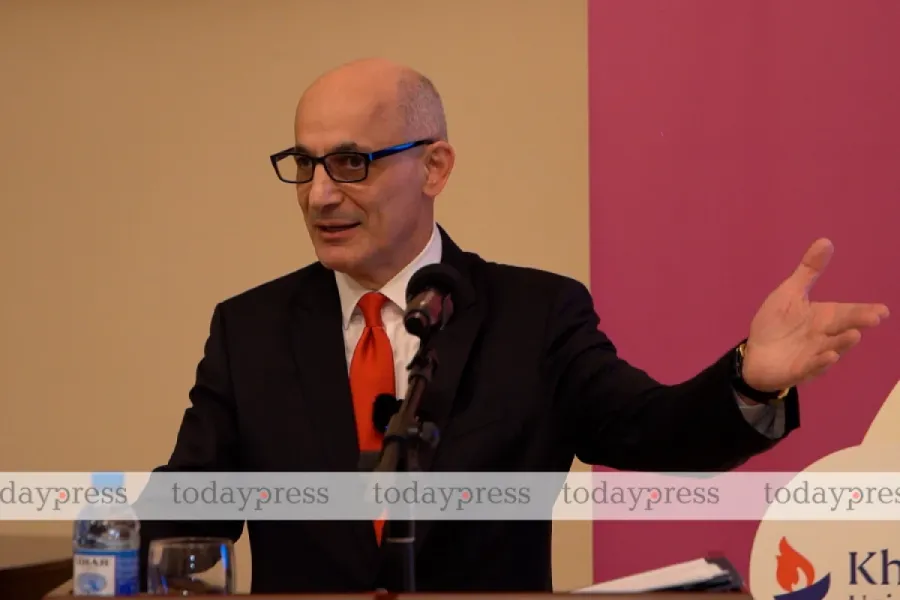
Ramis Yunus
Professor of Political Science
Khazar International University